
(Lindl.) Herb.
Description
Zephyranthes candida is native to the marshlands and riverbanks of the Río de la Plata region in Argentina and Uruguay, but has become one of the most widely naturalised bulbous plants in tropical and subtropical Asia, Africa, and Oceania. GBIF documents over 2,810 occurrences spanning more than 20 countries, with substantial records from the United States, Japan, India, China, and Australia. In the eastern Himalayas, it occurs as a naturalised garden escape in warm valleys and lowland settlements at elevations below 1,500 m. At Khoma in eastern Bhutan at 950 m, it grows along roadsides, field margins, and around homesteads, flowering abundantly in October during the late monsoon and post-monsoon period.
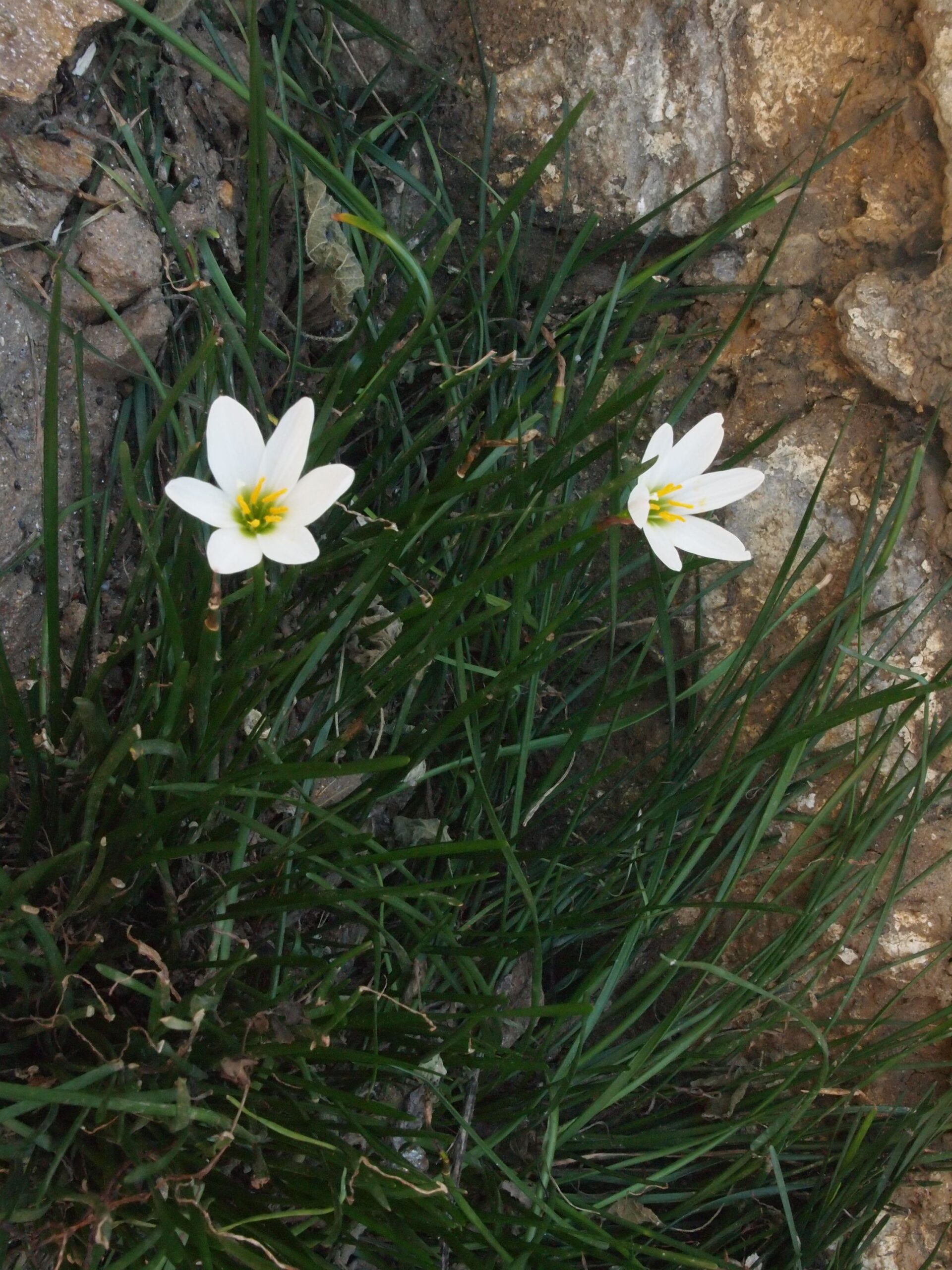
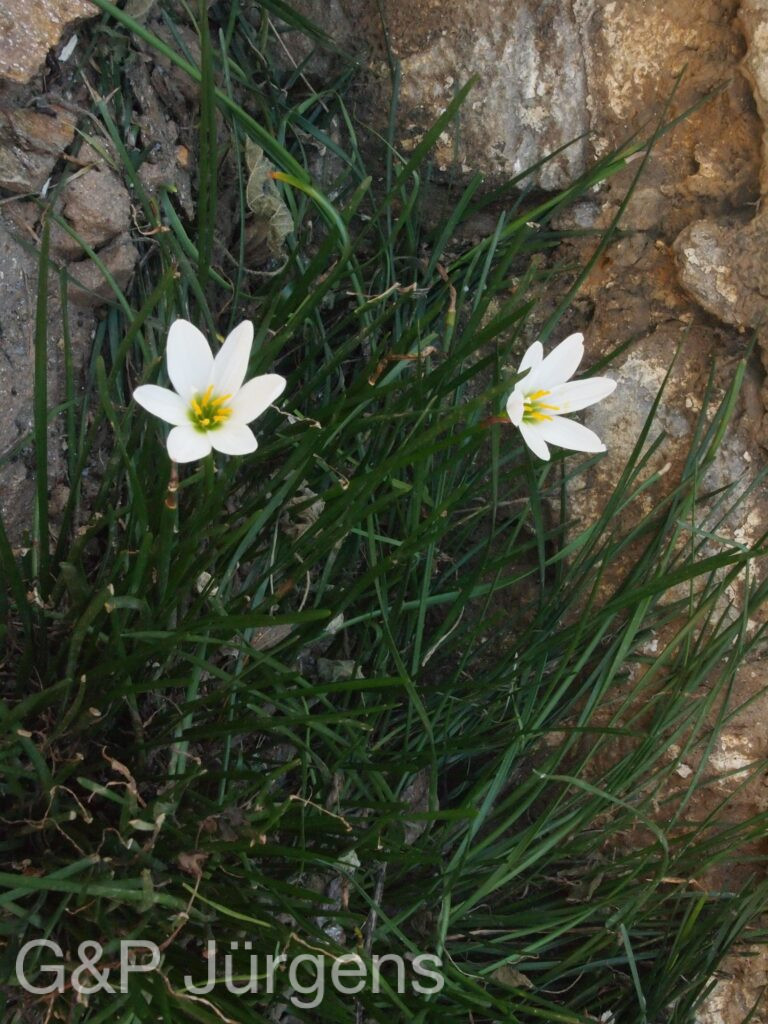
Zephyranthes candida is a bulbous perennial herb. The bulb is ovoid, 2–3 cm in diameter, with a dark brown tunic. Leaves are basal, linear, rushlike, 15–30 cm long and 2–4 mm wide, dark green, semi-erect, and persistent through much of the year. The scape is slender, hollow, 15–25 cm tall, bearing a single erect flower subtended by a tubular spathe. The flower is actinomorphic, crocus-like, 3–5 cm across, with six white tepals that are broadly elliptic and slightly tinged green at the base externally. Stamens are six, subequal, with yellow anthers. The ovary is inferior, trilocular; the fruit is a depressed-globose capsule containing flattened black seeds.
Despite its alien origin, Zephyranthes candida has become thoroughly established across warm regions of the Himalayan foothills and is now a familiar element of the naturalised flora of Bhutan, Nepal, and northeast India. Its rapid vegetative spread via daughter bulbs, tolerance of a wide range of soil moisture conditions, and prolific seed production contribute to its success as a coloniser of disturbed habitats. The species is taxonomically placed in Zephyranthes sensu lato; some recent molecular treatments have subsumed it within an expanded Habranthus, though most regional Floras retain the traditional placement.
Author: (Lindl.) Herb. · Sources: POWO (Kew), GBIF, Flora of China Vol. 24, Flora of Bhutan Vol. 3, Meerow & Snijman: Amaryllidaceae in Kubitzki: Families and Genera of Vascular Plants Vol. 3 (1998)