
Kurz
Description
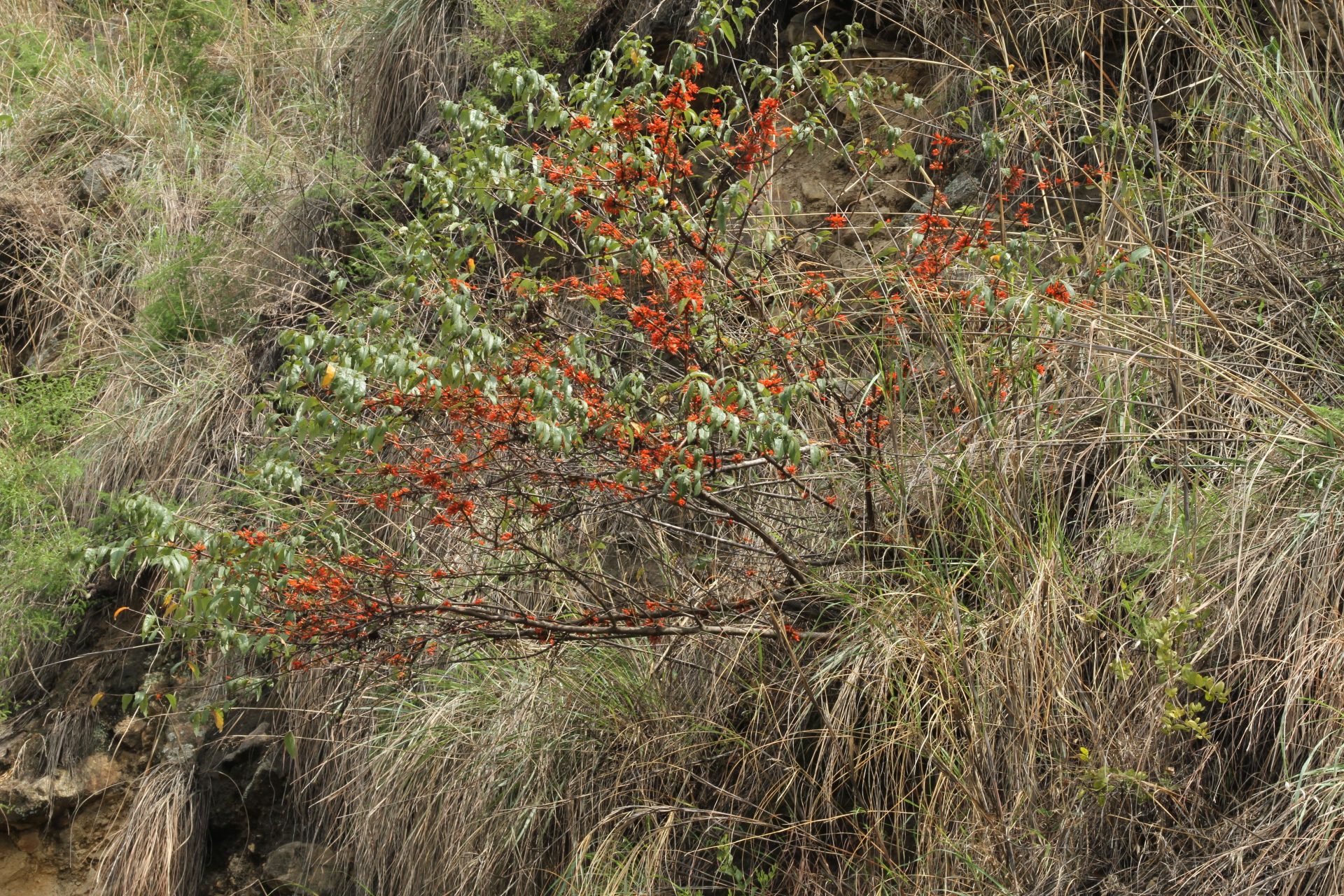
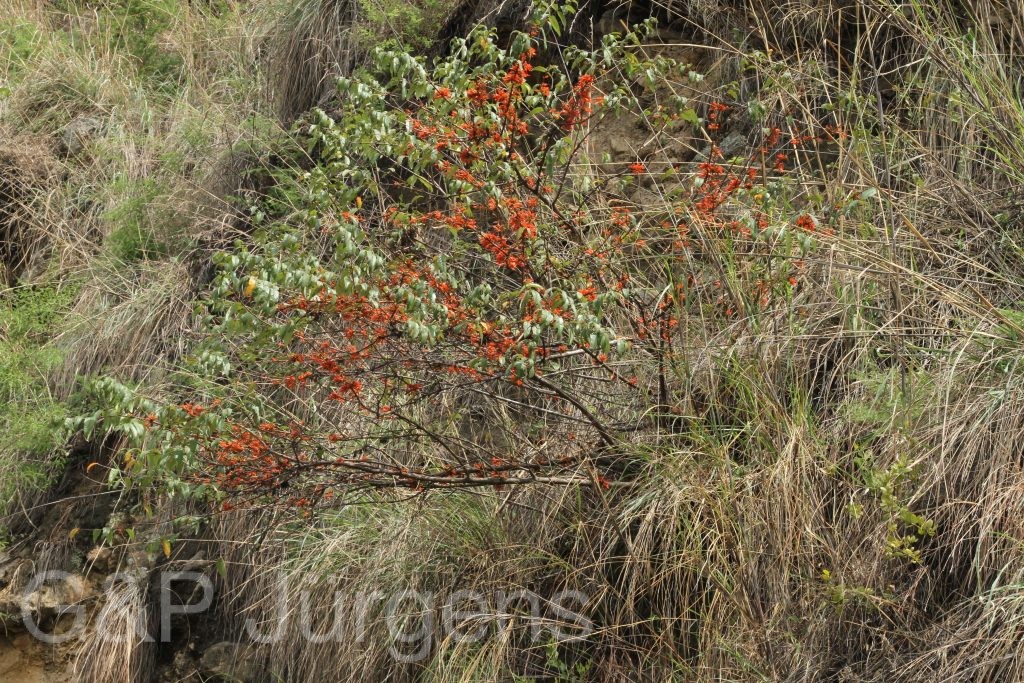
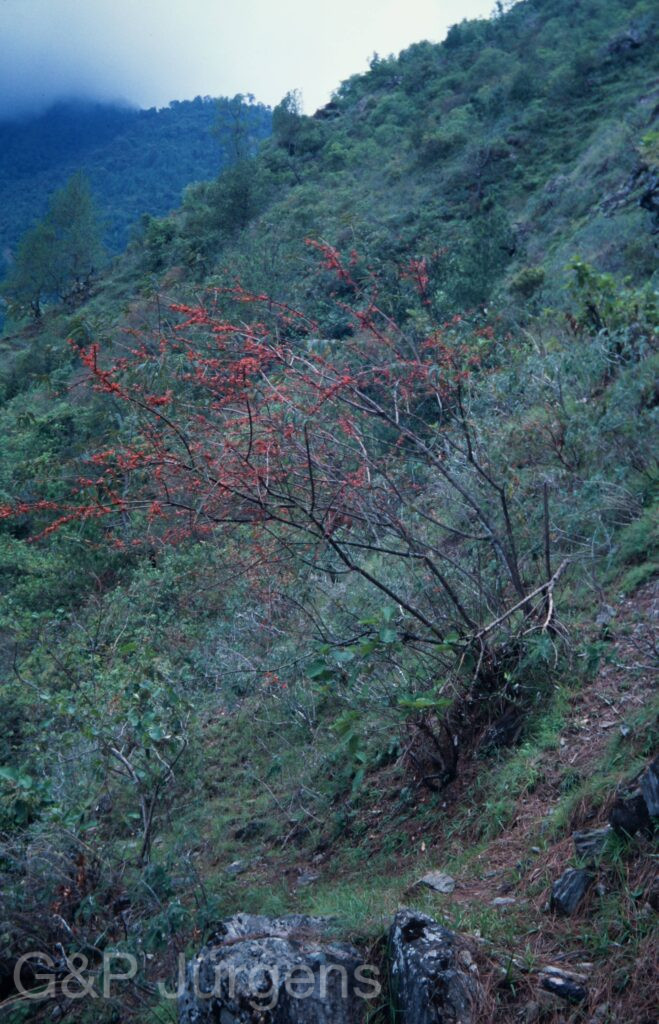
Woodfordia fruticosa is a widespread Old World shrub ranging from the Indian subcontinent through China and Southeast Asia to Madagascar and tropical Africa, with GBIF documenting around 1657 occurrences across India, China, Madagascar, Nepal, Indonesia, Sri Lanka, Myanmar, Pakistan, Bhutan, Bangladesh and Thailand. It is a plant of warm, seasonally dry habitats, characteristically colonising open hill slopes, rocky outcrops, scrub, forest margins and disturbed ground from the lowlands into the lower hills. The plants recorded at Trashigang in Bhutan at about 1470 m and at Gunda in Gorkha, Nepal at about 1700 m, both in May, illustrate its presence in the subtropical mid-hill zone, where it flushes with bright flowers at the onset of the warm season.
It is a much-branched deciduous shrub with long, often arching or pendulous branches and grey-brown bark. The leaves are opposite or subopposite, sessile to subsessile, lanceolate to oblong-lanceolate, entire-margined, dull green above and densely whitish- or rusty-tomentose and gland-dotted beneath. The flowers are clustered in short axillary cymes and are conspicuously bright red to orange-red; each has a tubular, slightly curved, ribbed calyx (hypanthium) with short triangular lobes, minute or vestigial petals, and numerous long-exserted stamens, giving the inflorescence a brush-like appearance. The fruit is a small ellipsoid capsule enclosed within the persistent calyx tube, releasing numerous tiny seeds.
The tubular red flowers and copious nectar of W. fruticosa make it strongly ornithophilous, attracting sunbirds and other nectar-feeding birds that act as pollinators, while it is also valued by beekeepers. Dried flowers (known as dhataki) are widely used in traditional medicine and notably as a natural fermentation agent in Ayurvedic preparations, owing to abundant tannins and polyphenols. The sole or near-sole member of its genus, the species is robust, fast-colonising and locally abundant, and is not of conservation concern.
Author: Kurz · Sources: POWO (Kew), GBIF, Flora of China Vol. 13, Flora of Bhutan Vol. 2, Flora of Nepal, Graham Revision of the Lythraceae of the Indian Subcontinent