
Hook.f. & Thomson
Description
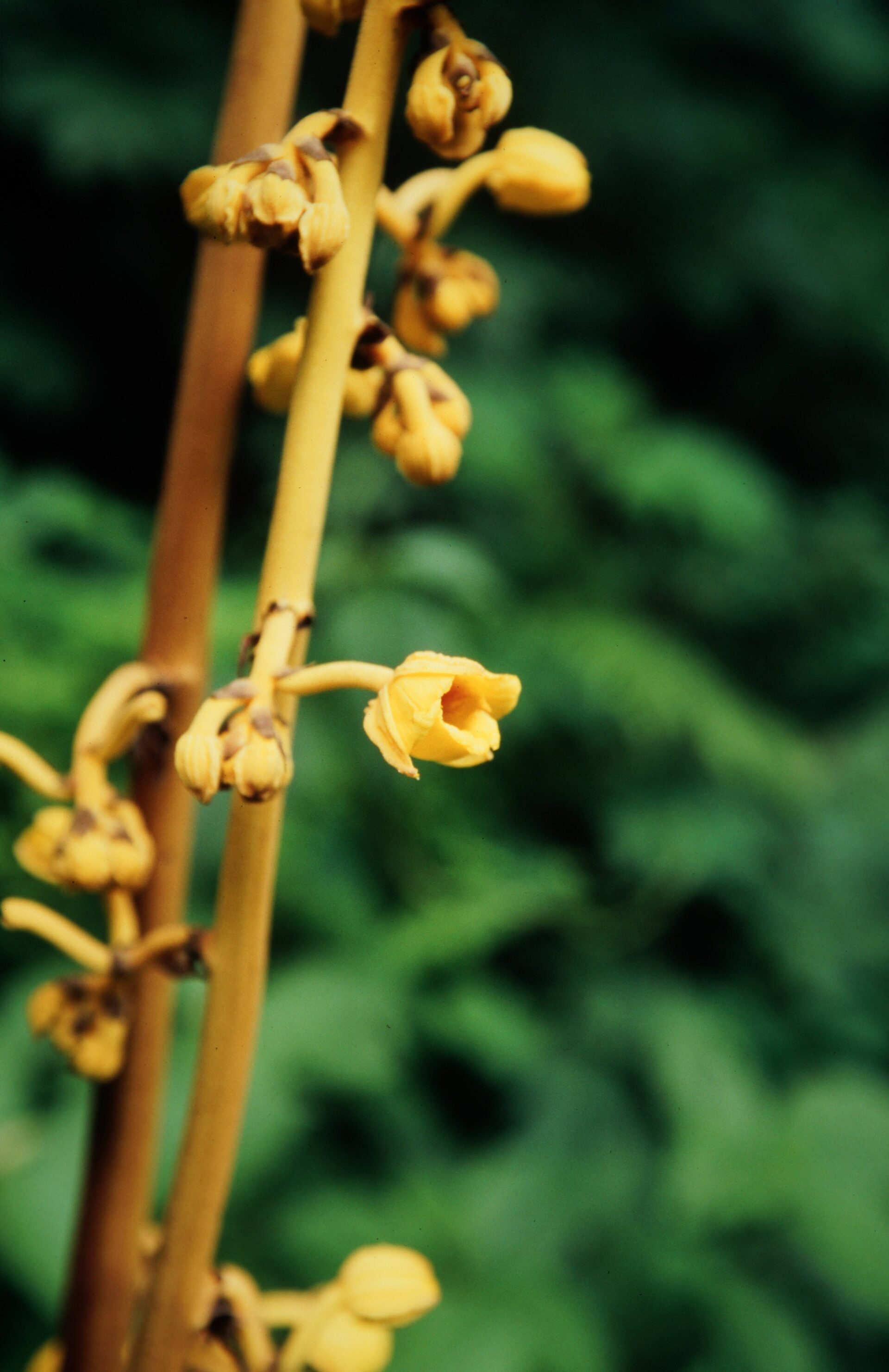
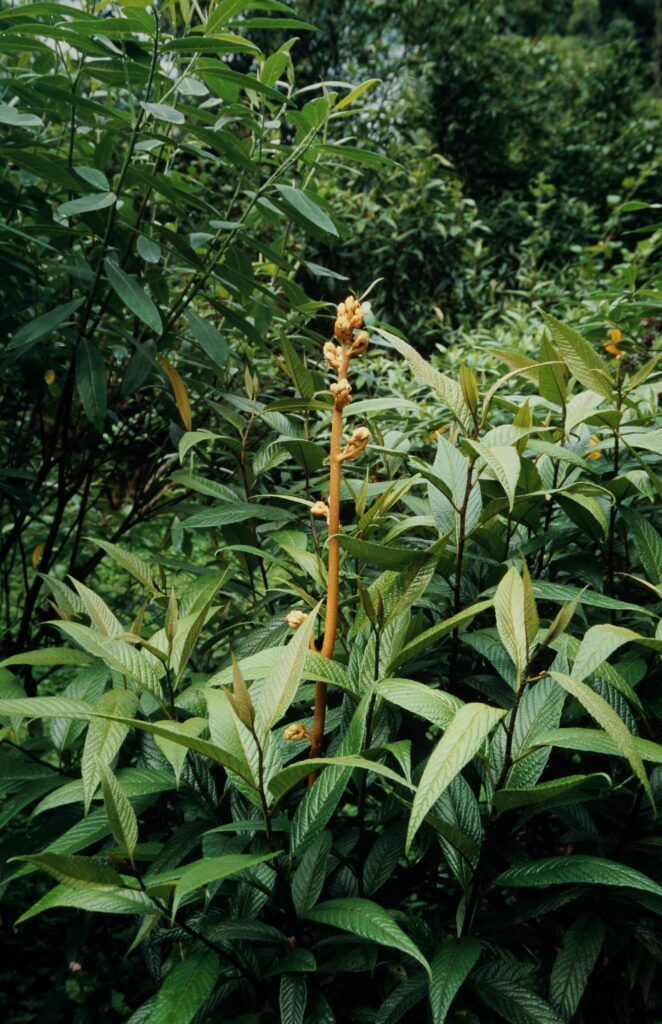
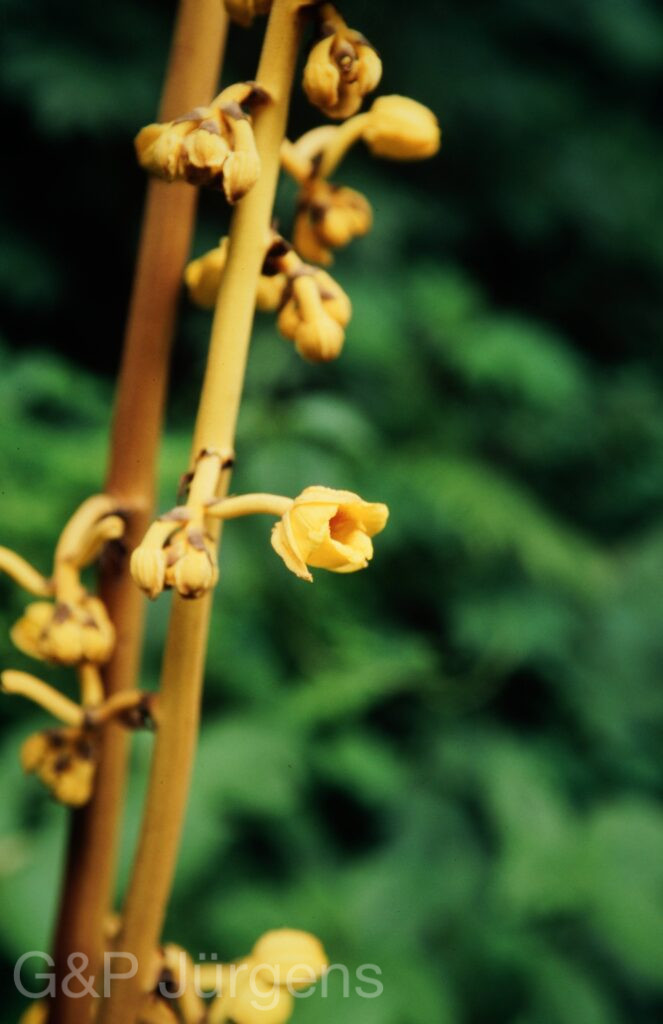
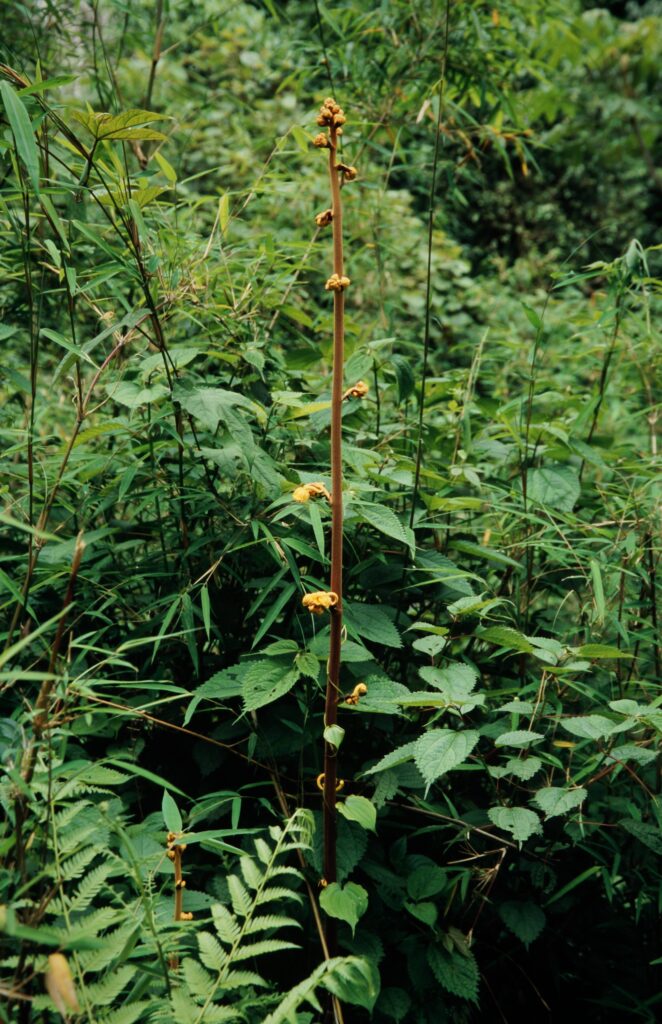
Cyrtosia lindleyana Hook.f. & Thomson is a leafless, mycoheterotrophic orchid of the tribe Vanilleae, distributed across the eastern Himalaya and into mainland and insular Southeast Asia. Its range, documented through some 400 georeferenced records, spans Nepal, northeast India, Bhutan, southern China, Taiwan, Myanmar, Vietnam and Indonesia. The species favours the deep humus and leaf litter of shaded, humid broad-leaved and mixed forests, where it depends on a mycorrhizal fungal partner for its entire nutrition. It typically occurs at montane elevations between roughly 1,500 and 2,800 m, consistent with the photographed population at Ringi-Chu near Tolung Gompa in Sikkim, recorded at 2,410 m in May.
Lacking chlorophyll, the plant emerges only to flower and fruit, arising from a stout, fleshy, coralloid rhizome that ramifies through the substrate. The erect, brownish to ochre, scale-clad inflorescence bears a loose raceme or panicle of comparatively large flowers. These are fleshy and yellowish, often suffused with brown or russet tones, with spreading sepals and petals and a concave, somewhat saccate lip bearing internal ridges. The fruit is distinctive among orchids: a large, fleshy, berry-like, indehiscent capsule, red at maturity, containing hard-coated seeds rather than the typical dust-fine orchid seed.
The genus Cyrtosia, together with allied Galeola, exemplifies the repeated evolution of full mycoheterotrophy within Vanilleae and is of considerable interest for studies of orchid–fungus associations. Because the plants are inconspicuous and only briefly visible, the species is easily overlooked and under-recorded. As an obligate forest-floor mycoheterotroph it is highly sensitive to logging and disturbance of soil mycota, and like all orchids is afforded protection under CITES Appendix II.
Author: Hook.f. & Thomson · Sources: POWO (Kew), GBIF, Flora of China Vol. 25, Flora of Bhutan Vol. 3, Pearce & Cribb: The Orchids of Bhutan (2002)