
DC.
Description
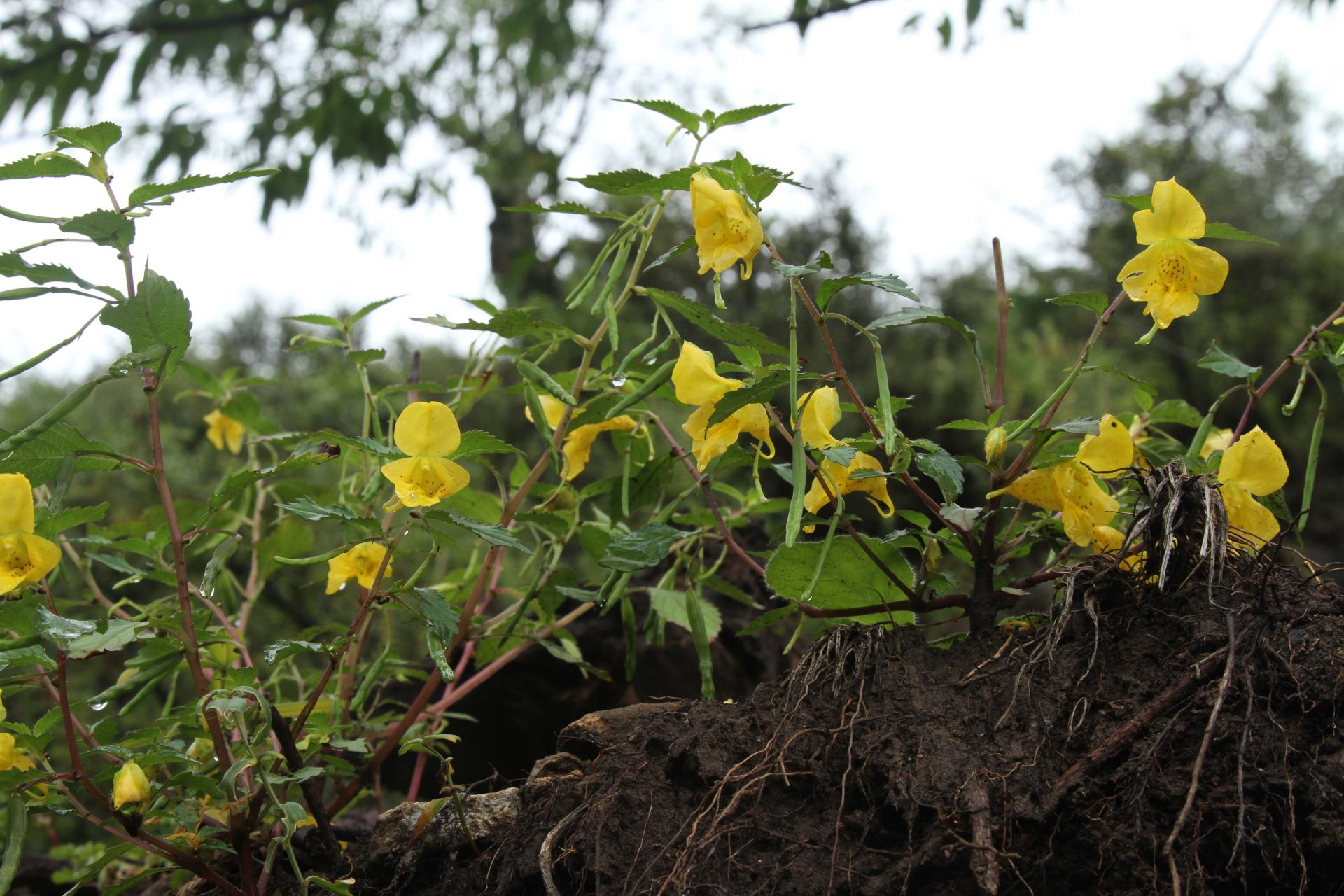
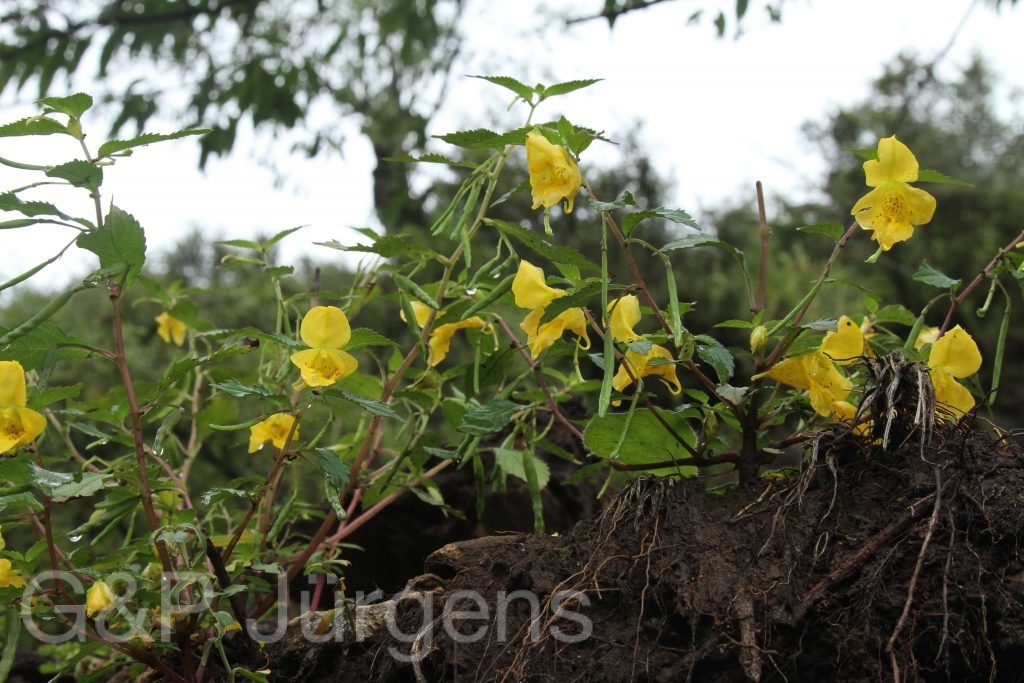
Impatiens scabrida is a robust annual balsam native to the Himalaya, its core range spanning India, Nepal, Pakistan, China and Bhutan, though GBIF's 243 occurrences also include many records from Europe and elsewhere (Portugal, the Netherlands, Great Britain, Germany, Poland and others), reflecting its naturalisation as a garden escape outside its homeland. In its native range it grows on moist shaded banks, forest margins, ravines and streamsides. The photographed plant is from the Haa Valley in Bhutan at about 3100 m, flowering in September, in cool, damp temperate woodland.
The plant is a succulent, erect annual with translucent, often reddish, branched stems that are scabrid (rough), as the epithet records. The leaves are ovate to lanceolate, serrate, with gland-tipped teeth. The yellow flowers are zygomorphic and spurred in the manner of the genus: a saccate lower sepal drawn into a slender curved spur, an upper standard petal and paired lateral united petals forming wings. The fruit is a fleshy, explosively dehiscent capsule that ejects its seeds on contact, giving balsams their touch-me-not behaviour.
The species is accepted. Impatiens is a vast, taxonomically complex genus centred on tropical Asia and Africa, with the Himalaya a major centre of diversity and endemism. The yellow-flowered Himalayan balsams are pollinated chiefly by long-tongued bees, and the ballistic seed dispersal aids rapid colonisation, the very trait underlying this species' spread in European riparian and disturbed habitats. Its naturalised populations make it a subject of interest in invasion ecology.
Author: DC. · Sources: POWO (Kew), GBIF, Flora of Bhutan, Grey-Wilson's monograph Impatiens of Africa and Asian studies, Flora of Nepal