
Wall.
Description
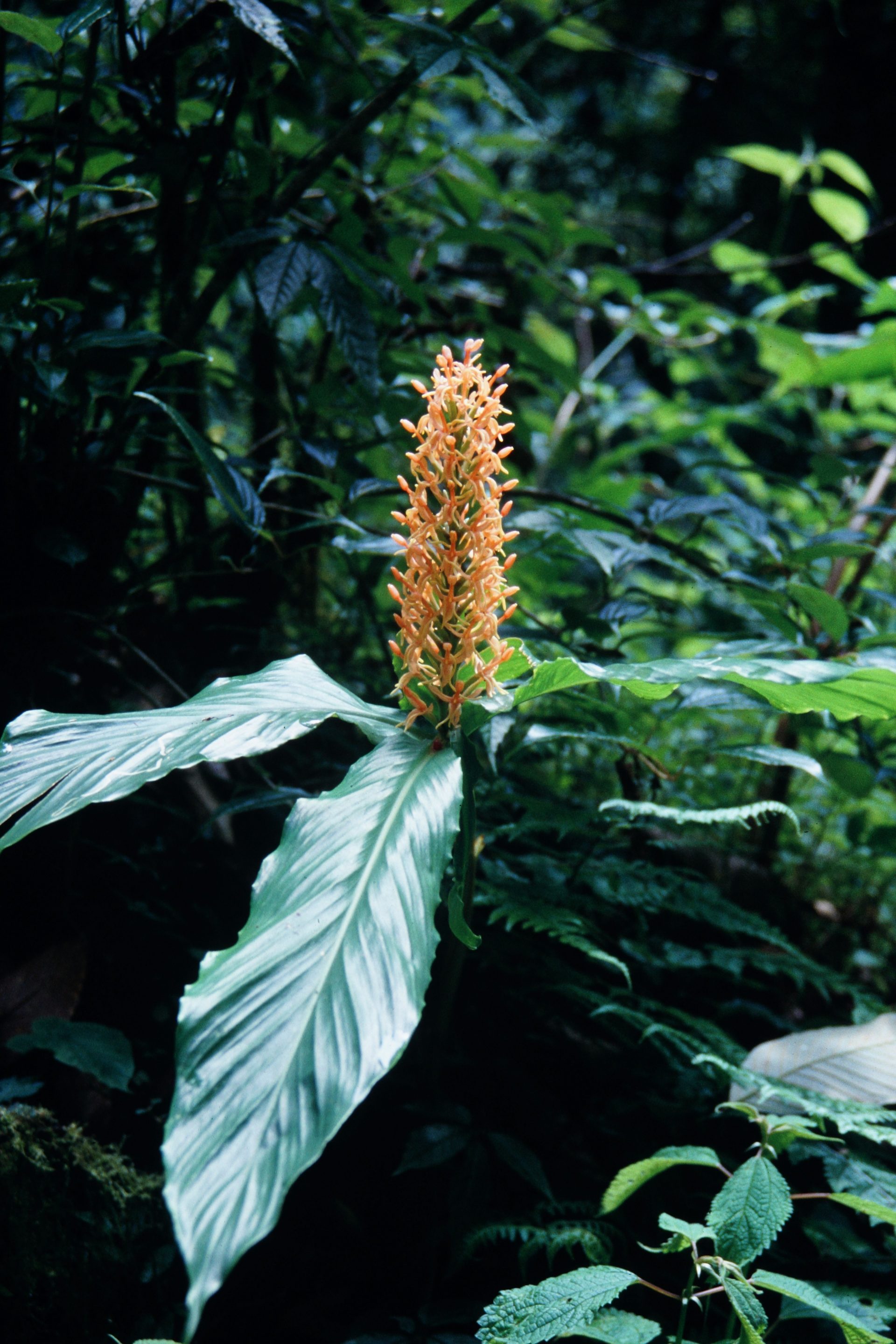
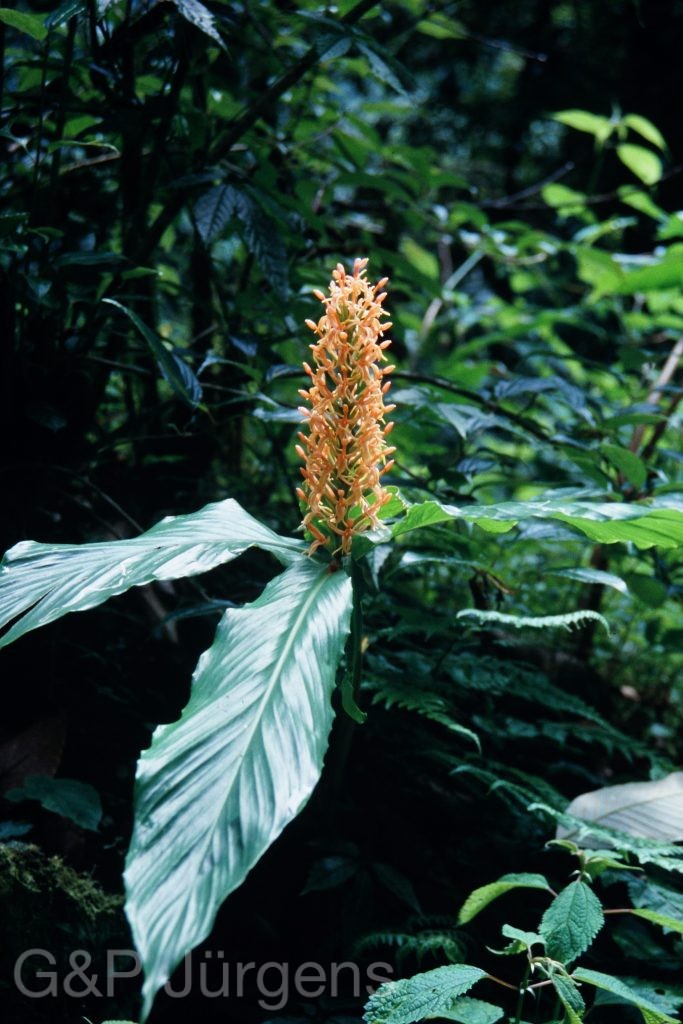
Hedychium densiflorum Wall. is a robust rhizomatous ginger native to the eastern Himalaya, ranging through China (CN), India (IN), Nepal (NP), Bhutan (BT) and Myanmar (MM); GBIF records 255 occurrences, with additional points from cultivation in Britain, North America and elsewhere reflecting its popularity as a hardy ornamental. In the wild it grows in moist temperate forest, shaded banks and clearings, frequently as an epilithic or terrestrial herb among rocks. It was photographed in Sikkim above Yoksam at 2600 m in August, in the cool, monsoon-drenched broadleaf forest belt that typifies its habitat.
The plant grows from a stout, aromatic, creeping rhizome, producing tall leafy pseudostems formed by overlapping leaf-sheaths. The leaves are distichous, oblong-lanceolate, acuminate and shortly petiolate, with a conspicuous membranous ligule. The inflorescence is a dense, narrowly cylindrical terminal spike, much denser than in most congeners, from which the epithet derives; the bracts are imbricate and each subtends one or more flowers. The flowers are slender and orange to soft yellow, with a long corolla tube, narrow petals, a prominent exserted filament bearing the anther, and a bilobed or entire labellum. The fruit is a globose capsule splitting to reveal seeds enclosed in a bright arillus.
Hedychium belongs to tribe Zingibereae and is centred on the Indo-Malayan and Himalayan region, where many species are pollinated by moths and butterflies attracted to the long-tubed, often fragrant flowers. H. densiflorum and its selections such as 'Assam Orange' and 'Stephen' are widely grown for their hardiness. The original family field, spelled "Zingiberacaea", is retained verbatim though the correct orthography is Zingiberaceae. The species faces localised pressure from forest disturbance but remains common across its range.
Author: Wall. · Sources: POWO (Kew), GBIF, Flora of Bhutan, Flora of China, Zingiberaceae monograph (Schumann; T. L. Wu & K. Larsen)