
Benth.
Description
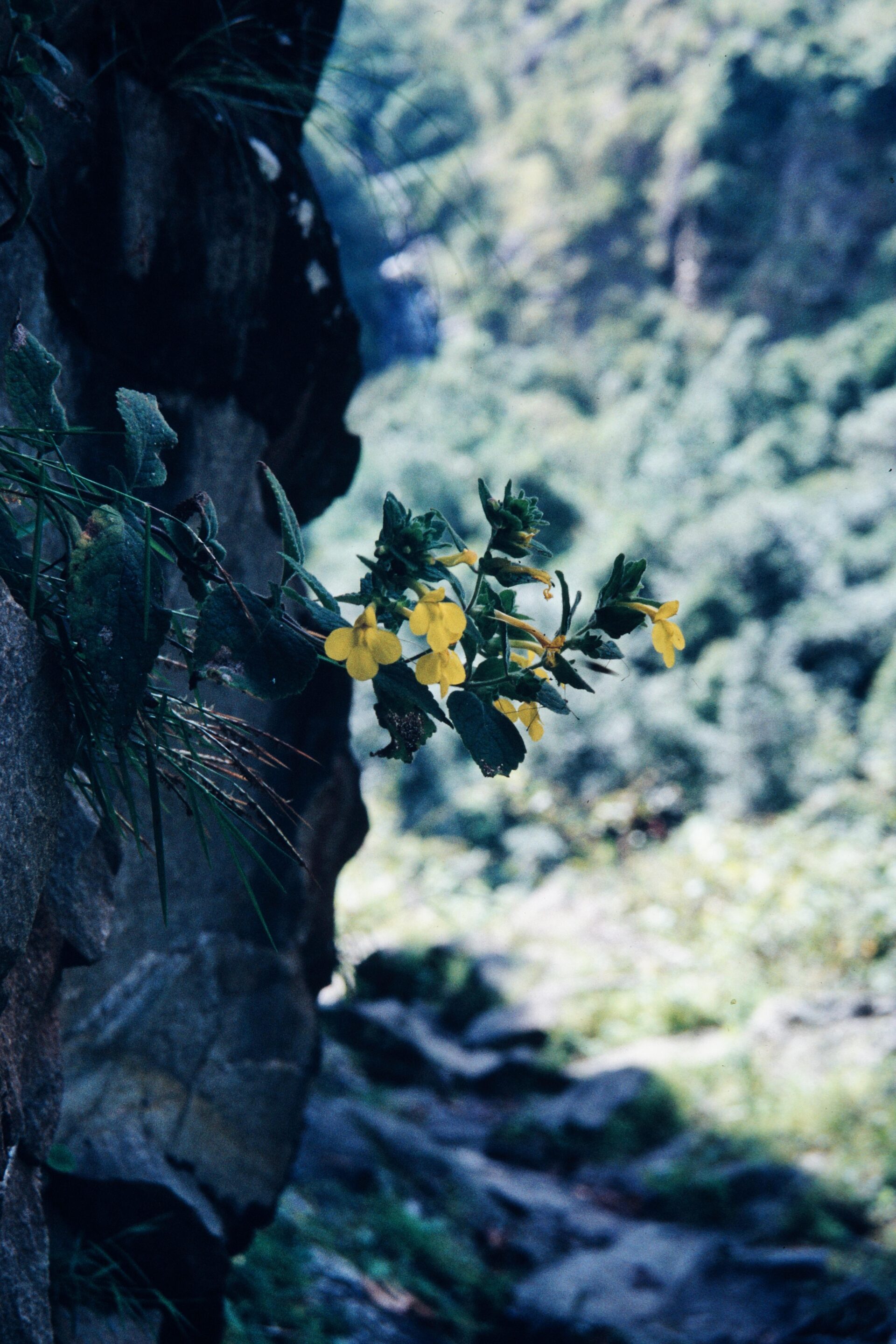
Lindenbergia grandiflora is a Himalayan herb ranging from Nepal and northern India through Bhutan into south-western China, with naturalised or introduced records noted elsewhere (including Italy and Vietnam among the catalogued occurrences). It is characteristically a plant of rocky places, old walls, dry banks, cliff ledges and other lithic, sun-exposed habitats at low to mid elevations, broadly between about 700 and 2,400 m. The plant photographed in the valley of the Buri Gandaki at Kholabensi, Nepal, at 2,100 m in October, captures its autumn flowering on the steep, well-drained slopes of an inner Himalayan river gorge.
It is an erect, branched, glandular-pubescent perennial or biennial herb with somewhat woody-based stems. The leaves are opposite below, ovate to lanceolate, with crenate-serrate margins and a softly hairy surface. The flowers are borne in the upper leaf axils, forming a leafy terminal raceme; the corolla is comparatively large for the genus, bright yellow, weakly two-lipped with a short tube and spreading lobes, the throat often bearing reddish markings. The calyx is campanulate and five-toothed; stamens four, didynamous. The fruit is a septicidal capsule with numerous small seeds.
Lindenbergia, formerly placed in Scrophulariaceae, is now referred variously to Orobanchaceae or, as here, to Plantaginaceae depending on classification; molecular studies place it among the basal, non-parasitic lineages near the Orobanchaceae, unlike its hemiparasitic relatives. The genus is a small Old World group centred on tropical Asia and Africa. The species is locally frequent on suitable rocky substrates and is not regarded as threatened.
Author: Benth. · Sources: POWO (Kew), Flora of China Vol. 18, Flora of Bhutan Vol. 2, GBIF, Fischer: Scrophulariaceae (Genera Orobanchaceae & allies)