
(Raf.) N.Tanaka

Description
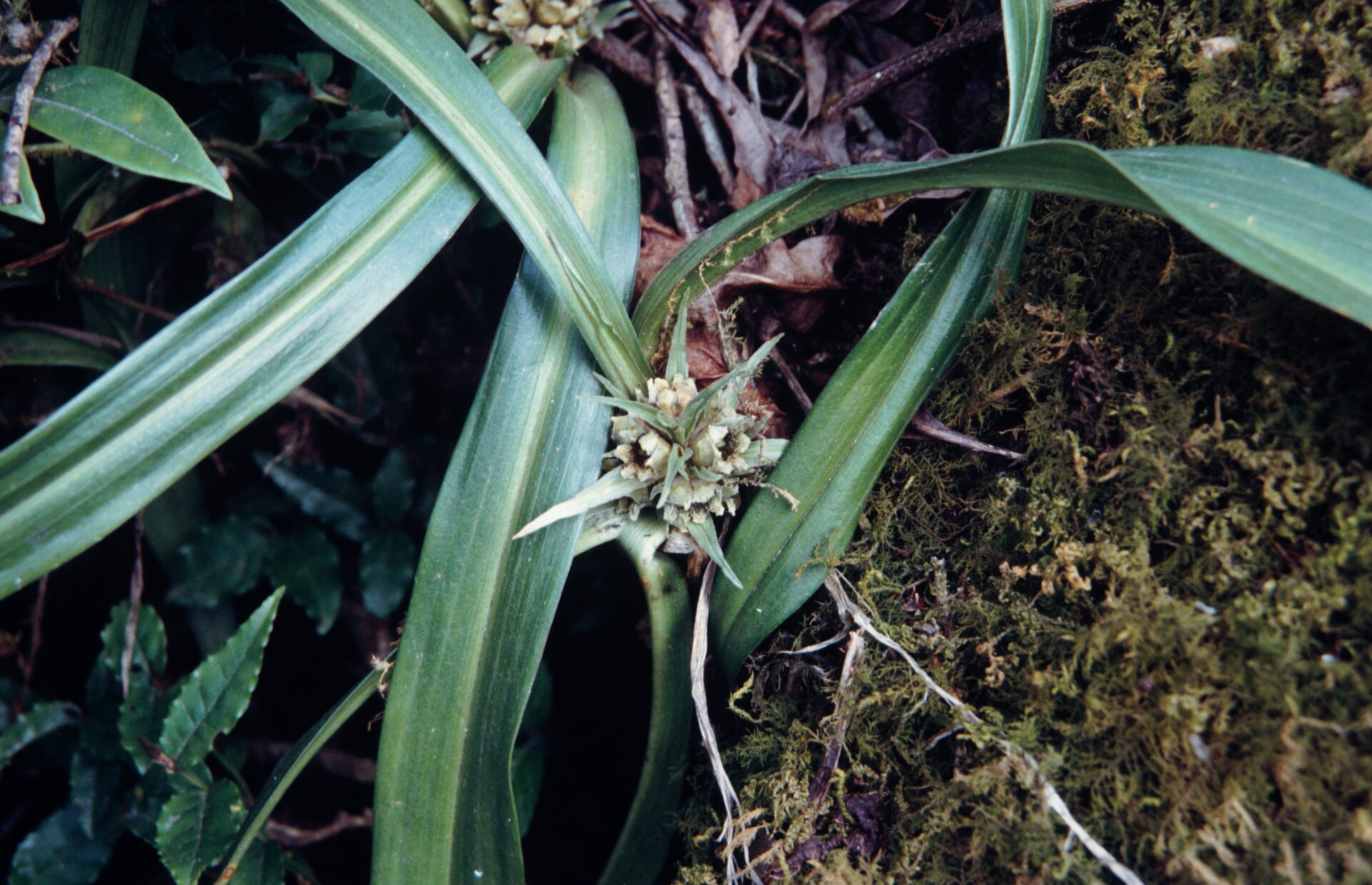
Rohdea nepalensis is a rhizomatous perennial herb of the Himalaya and adjacent montane Asia, documented by GBIF from China, India, Nepal, Bhutan, Myanmar, Bangladesh and Thailand across some 133 occurrences. It is a forest-floor species of shaded, moist broadleaved and evergreen forest, growing on humus-rich slopes, banks and rocky ground in the subtropical to warm-temperate zone. The photographed plant was recorded in Nepal in the Simbua-Khola at 2000 m in March, an early-season flowering in the cool, damp understorey characteristic of the species.
It forms clumps from a short, stout rhizome and produces basal, distichous, strap-shaped to oblanceolate leaves that are leathery, arching, prominently veined and tapered to a sheathing base. The inflorescence is a short, dense, sessile or shortly pedunculate spike borne near ground level, carrying numerous small, crowded flowers; each flower has a fleshy, urceolate to campanulate perianth of six connate tepals, usually pale yellow to greenish, with six included stamens and a superior ovary. The fruit is a one- to few-seeded berry that ripens red.
GBIF accepts the name, recombined by N. Tanaka, who expanded Rohdea to include species formerly placed in Tupistra and Campylandra; under that classification the plant appears in older literature under those genera. It is treated within an enlarged Asparagaceae (subfamily Nolinoideae, the former Convallariaceae/Ruscaceae). Several Rohdea are cultivated as evergreen ornamentals and used in traditional medicine. Widely distributed in suitable forest, R. nepalensis is of no conservation concern.
Author: (Raf.) N.Tanaka · Sources: POWO (Kew), GBIF, Flora of China, Flora of Nepal, Tanaka revision of Rohdea