
(Wall.) LaFrankie
Description
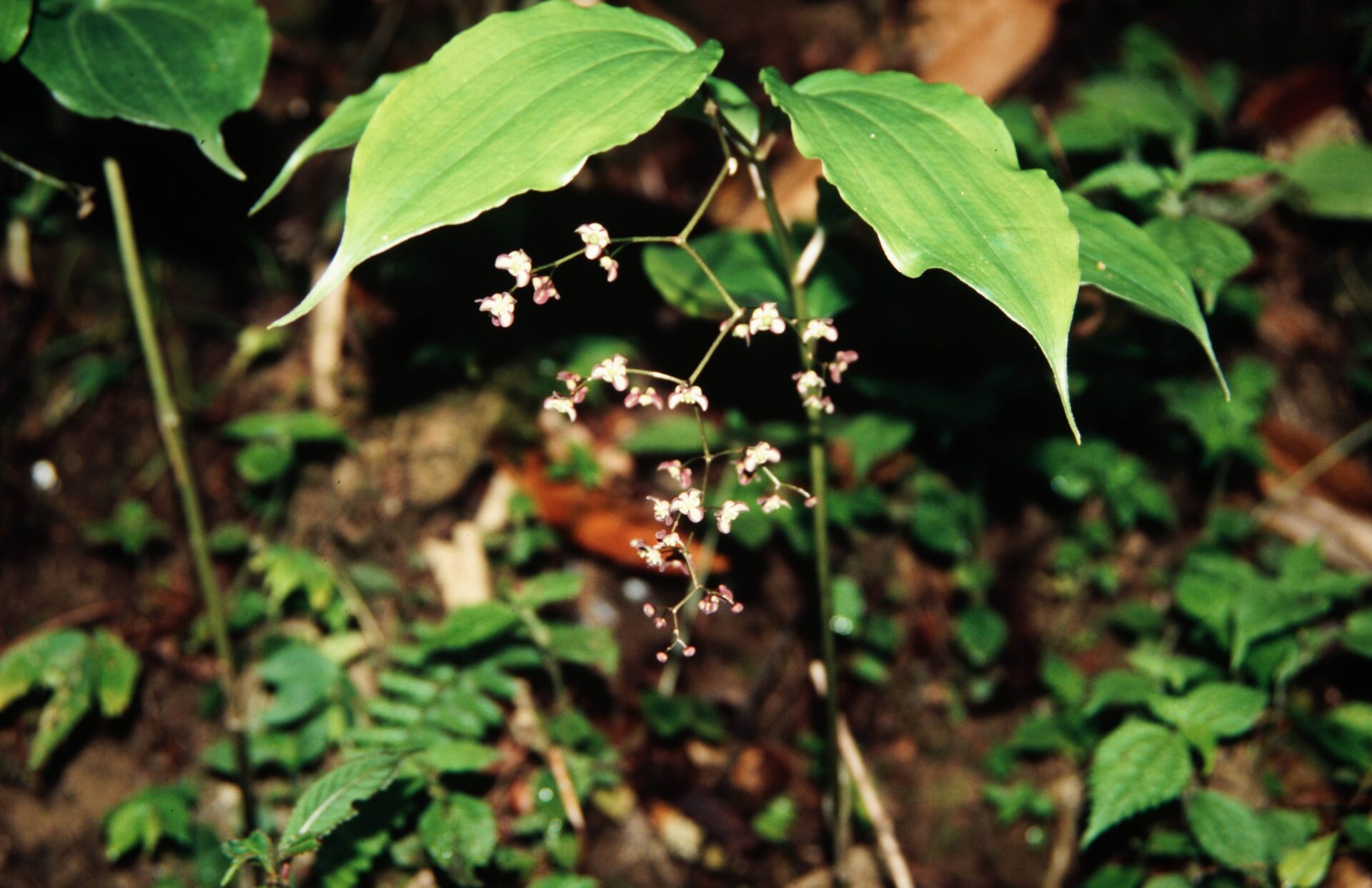
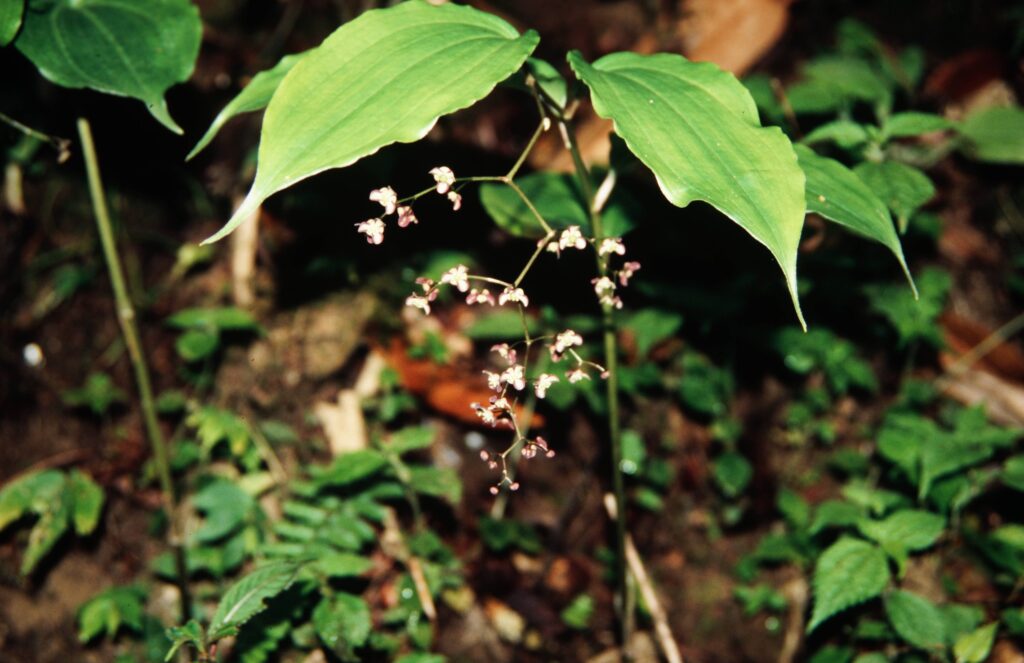
Maianthemum fuscum is a rhizomatous woodland herb of the eastern Himalaya and adjacent mountains of southwestern China, recorded by GBIF from China, India, Nepal, Myanmar, Bhutan and Vietnam across roughly 303 georeferenced occurrences. It inhabits cool, moist, shaded broadleaf and mixed forest, growing on humus-rich slopes, beneath rhododendron and oak canopy, and along streamsides in the temperate montane belt, generally between about 1,800 and 3,000 m. The photographed plant from Ramman in the Darjeeling hills of West Bengal, India, at around 2,100 m in May is representative of its pre-monsoon flowering, the inflorescences appearing as the new leafy shoots unfurl on the forest floor.
The plant arises from a slender creeping rhizome bearing an erect, often arching aerial stem with several alternate, sessile to short-petioled leaves that are ovate to ovate-lanceolate, acuminate and prominently parallel-veined. The inflorescence is a terminal raceme or narrow panicle of small flowers, each flower with a typically six-parted perianth of free or basally connate tepals that are dull purplish-brown to dark maroon, giving the species its epithet fuscum ("dusky"). There are six stamens and a superior ovary maturing into a small globose berry that ripens through mottled to red or purplish-black, containing few seeds and dispersed by birds.
Maianthemum fuscum was long placed in the genus Smilacina, and its transfer reflects the modern circumscription of Maianthemum to encompass the trimerous-flowered Asian "false Solomon's seals" alongside the dimerous North-temperate species; the family placement follows the broad Asparagaceae of APG, the group having previously been treated under Convallariaceae or Liliaceae. Within the Himalaya it is one of several closely related forest Maianthemum species whose vegetative similarity makes them dependent on floral and fruit characters for reliable identification. The species is locally common, not regarded as threatened, but like other shade-demanding rhizomatous herbs it is sensitive to canopy loss and forest disturbance.
Author: (Wall.) LaFrankie · Sources: POWO (Kew), GBIF, Flora of China Vol. 24, Flora of Bhutan Vol. 3, Flora of Nepal, Flora of Pakistan, LaFrankie's revision of Maianthemum (Smilacina) and the Convallariaceae