
(Hook.f. & Thomson) H.Keng
Description
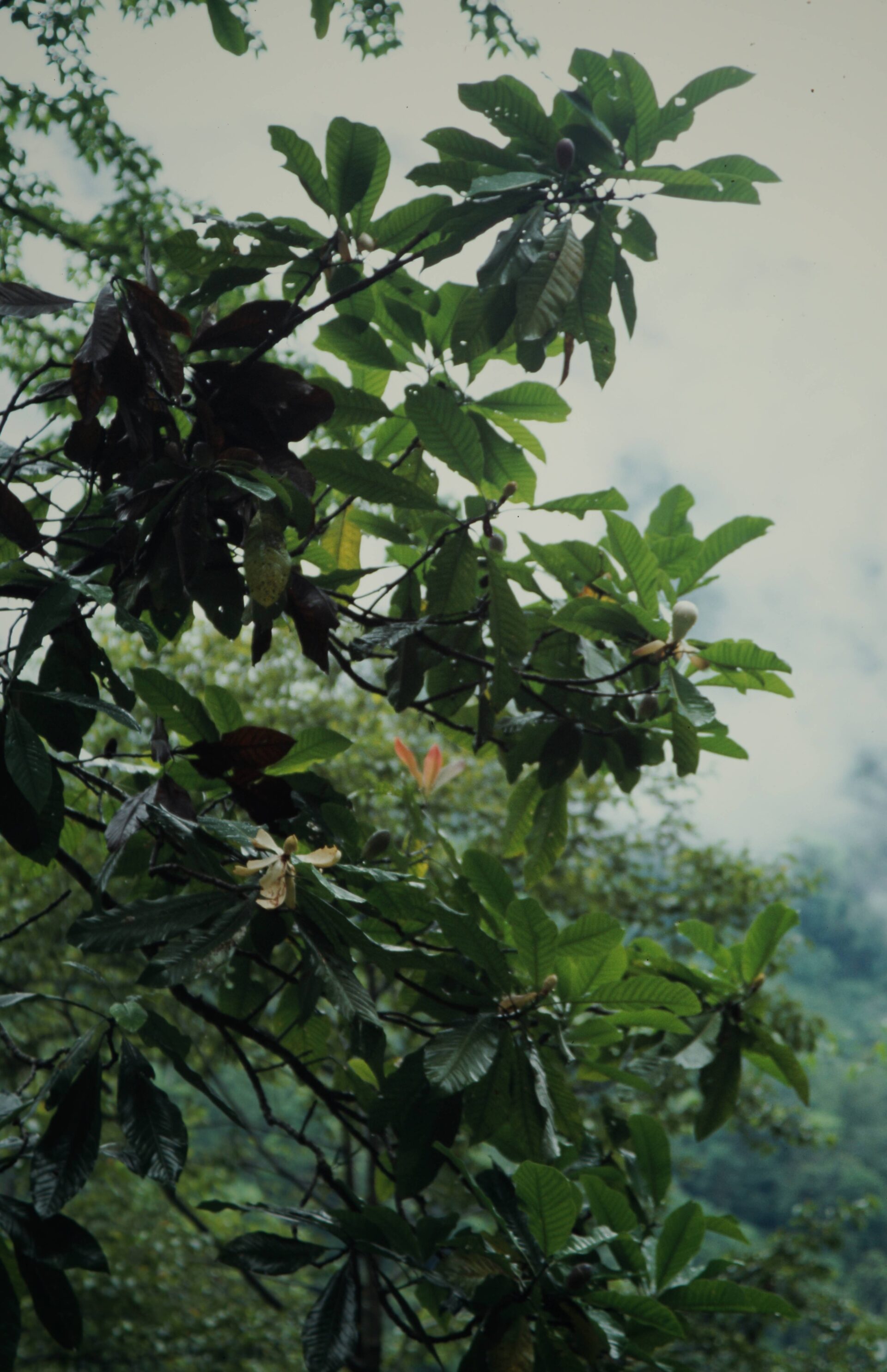
Magnolia hodgsonii is an evergreen tree of the eastern Himalaya and adjacent Southeast Asia, distributed through northeast India, Nepal, Bhutan, southern China (Yunnan, Xizang), Myanmar, Thailand, Vietnam and into Malesia. It is a component of warm, humid subtropical to lower montane broad-leaved evergreen forest, favouring sheltered valleys, ravines and moist hill slopes on deep soils. It generally occurs from the lowlands to around 1,800 m; the tree photographed at Chaana in the Darjeeling hills of West Bengal at 1,700 m in May exemplifies its upper subtropical forest habitat, flowering at the close of the dry season.
The plant is a medium-sized to large tree with smooth grey bark and stout twigs. The leaves are large, alternate, often clustered toward the branch tips, obovate to elliptic-oblong, coriaceous, glabrous and entire, with a prominent venation. The solitary, terminal flowers are large and fragrant, with creamy-white to pale yellow tepals arranged in several whorls; the numerous stamens and the apocarpous gynoecium of free carpels are borne on an elongate floral axis. The fruit is an ellipsoid to ovoid aggregate of follicles which split to expose seeds enveloped in a fleshy red to orange sarcotesta, dispersed by birds.
The species, with basionym attributed to Hooker f. and Thomson and recombined by H. Keng, was formerly placed in the segregate genus Talauma, now subsumed within a broadly circumscribed Magnolia. As an archaic, beetle-pollinated member of one of the most basal angiosperm lineages, it is of considerable evolutionary interest. Valued for its timber and ornamental flowers, it is subject to selective logging and forest clearance, and warm-temperate populations on the forest fringe merit monitoring where habitat loss is ongoing.
Author: (Hook.f. & Thomson) H.Keng · Sources: POWO (Kew), Flora of China Vol. 7, Flora of Bhutan Vol. 1, GBIF, Figlar & Nooteboom: Magnoliaceae notes