
(J.Koenig) Govaerts
Description
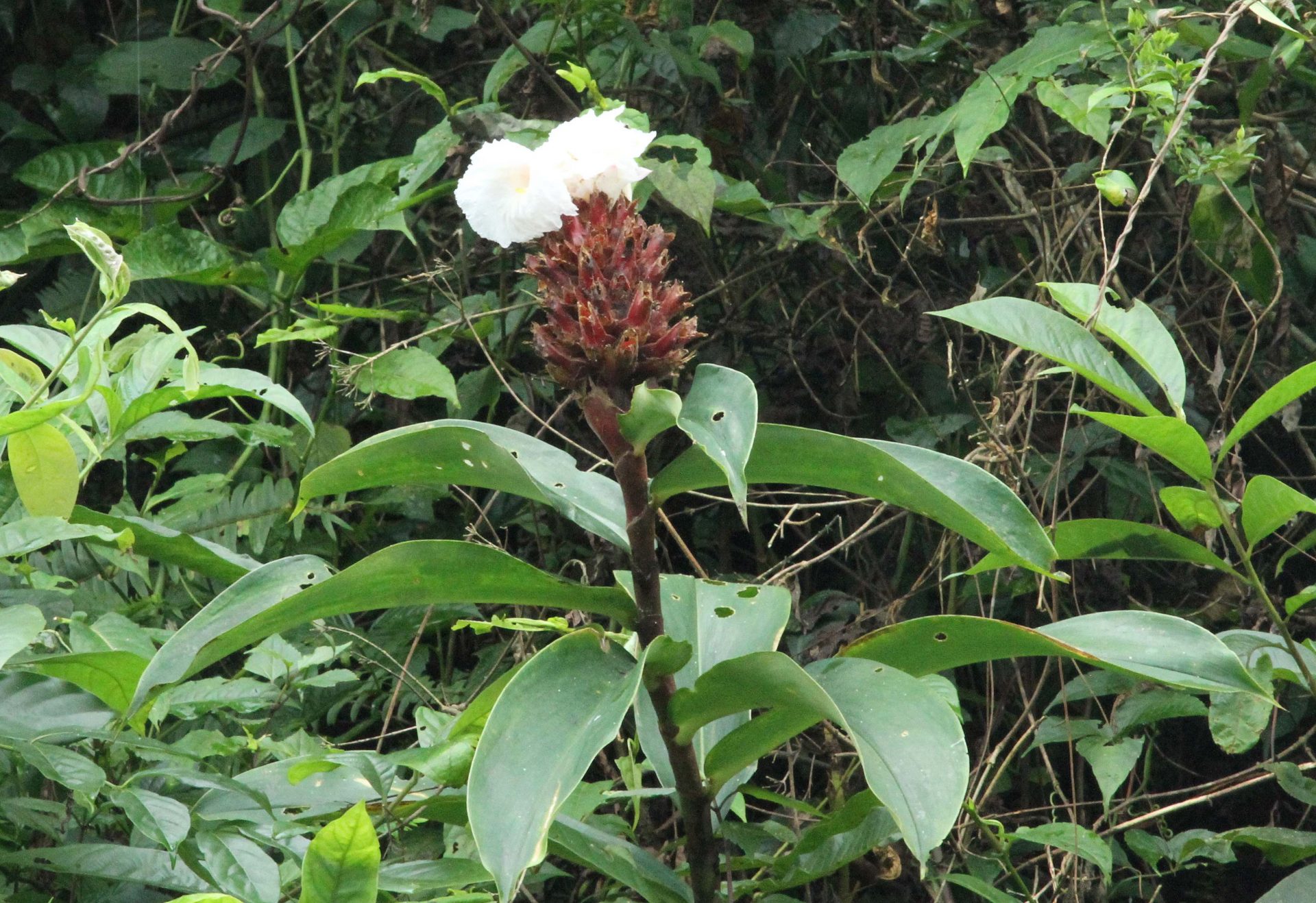
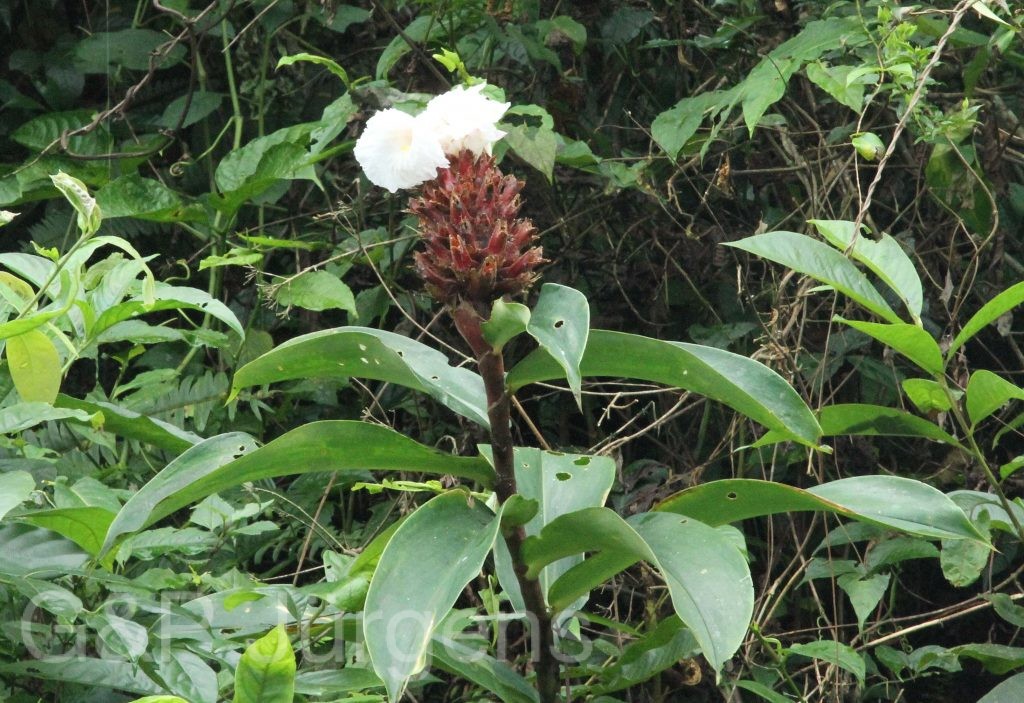
Hellenia speciosa is a robust rhizomatous herb of tropical and subtropical Asia, very widely distributed from India and Sri Lanka through Myanmar, Thailand, Malaysia, Indonesia, the Philippines and southern China to New Guinea and Australia, and widely cultivated and naturalised in the Neotropics and Pacific; its more than 6600 georeferenced records reflect this broad range and horticultural spread. It grows in moist forest understorey, forest margins, stream banks and disturbed ground, generally from near sea level to about 1200 m. The plant photographed at Galephu in southern Bhutan at 850 m in October grows in the warm subtropical foothill forest at the Himalaya's lowland fringe.
It is a tall, leafy herb 1-3 m high with a creeping fleshy rhizome and stout, characteristically spirally twisted leafy stems. The leaves are large, oblong-lanceolate, spirally arranged, with conspicuous sheaths. The inflorescence is a dense terminal cone-like spike of bright red, imbricate bracts from which emerge the showy flowers; each has a large, crinkled, funnel-shaped white labellum with a yellowish centre, subtended by a single fertile stamen with a petaloid filament. The fruit is a globose to ovoid red capsule containing numerous black, arillate seeds.
Formerly placed in Costus as Costus speciosus, the species was transferred to Hellenia by Govaerts; the input labels the family "Zingiberacaea" (Zingiberaceae), retained here verbatim, though the spiral-leaved costaceous gingers are now usually treated as a distinct family. The rhizome, rich in diosgenin, is widely used in traditional medicine and as a steroid precursor. The flowers are bee-pollinated and the bright capsules attract birds. Widespread, weedy and frequently cultivated, H. speciosa is of no conservation concern.
Author: (J.Koenig) Govaerts · Sources: POWO (Kew), GBIF, Flora of Bhutan, Flora of China, Flora of British India, Specht's monograph of Costus and allied genera (Costaceae)