
Buch.-Ham. ex D. Don

Description
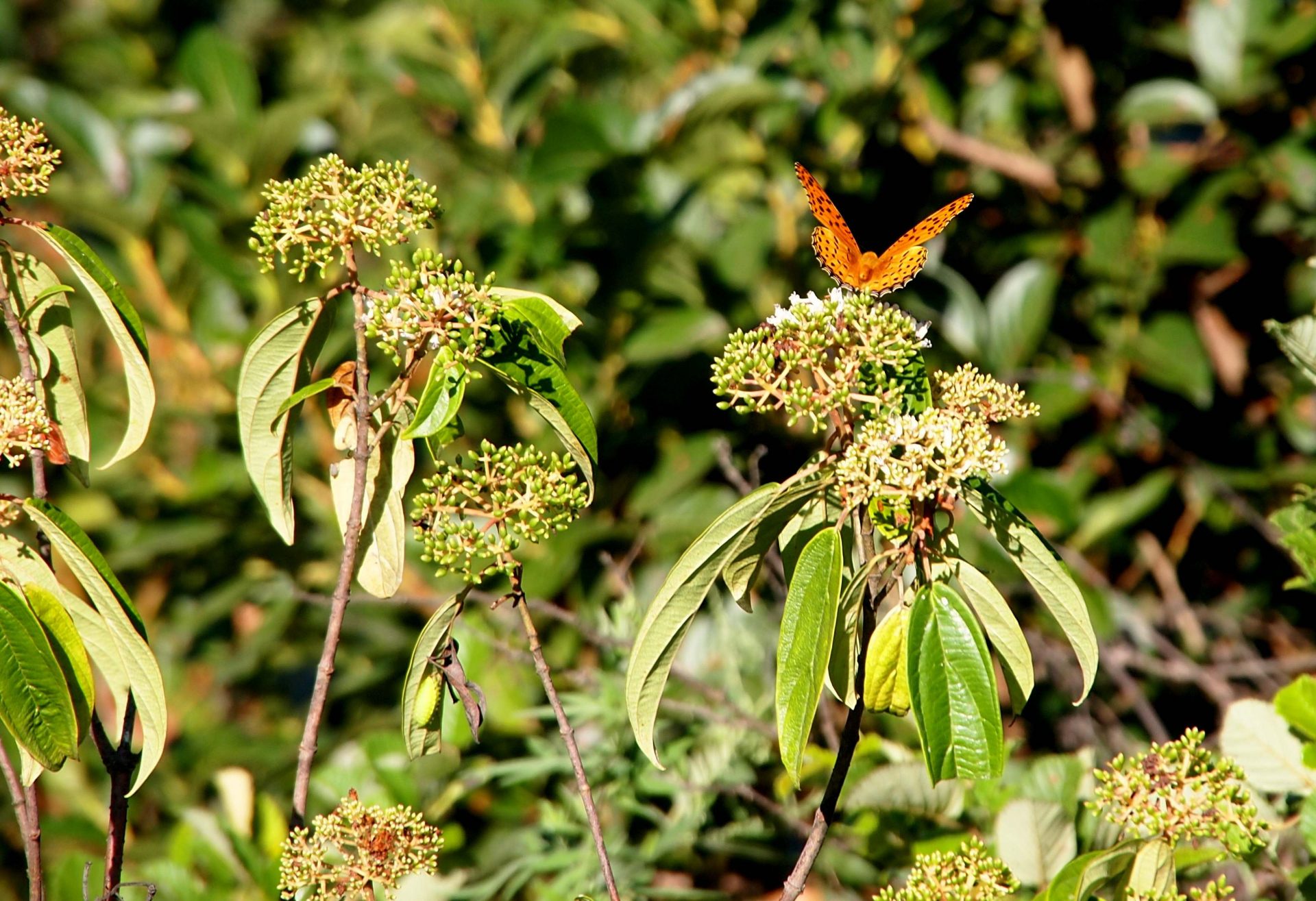
Viburnum cylindricum is a widespread evergreen or semi-evergreen shrub to small tree of the Sino-Himalayan and Indochinese region, exceptionally well documented with over 5700 GBIF occurrences spanning China, Nepal, India, Thailand, Myanmar, Bhutan, Vietnam, Laos and beyond, together with numerous cultivated and introduced records in Europe, North America and elsewhere reflecting its horticultural use. It grows in open forests, thickets, forest margins and scrub on hill slopes, typically between 1000 and 3000 m. The plant photographed near Wangdi in Bhutan at about 2400 m in September occupies this mid-montane belt, flowering and fruiting in the post-monsoon period within the warm-temperate broad-leaved forest zone of the eastern Himalaya.
It is an erect, glabrous-twigged shrub or small tree reaching several metres, immediately recognisable by its leathery, glaucous leaves whose surface bears a waxy bloom that can be marked or written upon. The leaves are opposite, simple, elliptic to oblong, entire or obscurely toothed towards the apex, and often somewhat blue-grey beneath. The inflorescence is a large, flat-topped to slightly domed terminal compound cyme of small white to pinkish-white flowers, each with a five-lobed campanulate to tubular corolla and long-exserted stamens that give the open umbel a delicate, brush-like appearance. The fruit is a small ovoid to ellipsoid drupe ripening from red to blue-black, containing a single compressed stone and dispersed by birds.
Viburnum is now placed in Adoxaceae following molecular phylogenetic revision of the old Caprifoliaceae, and V. cylindricum belongs to section Megalotinus, a predominantly tropical to subtropical Asian assemblage. The waxy, exserted-stamened flowers and bird-dispersed drupes are typical of the section. The species is locally used in traditional medicine, and the leaf wax has been put to minor practical uses. Owing to its very broad geographic and altitudinal range and tolerance of disturbed habitat it is of no conservation concern, ranking among the most frequently encountered viburnums of the eastern Himalaya and southwestern China.
Author: Buch.-Ham. ex D. Don · Sources: POWO (Kew), GBIF, Flora of China Vol. 19, Flora of Bhutan Vol. 2, Flora of Nepal, Kern Revision of Viburnum sect. Megalotinus