
K.Schum.
Description
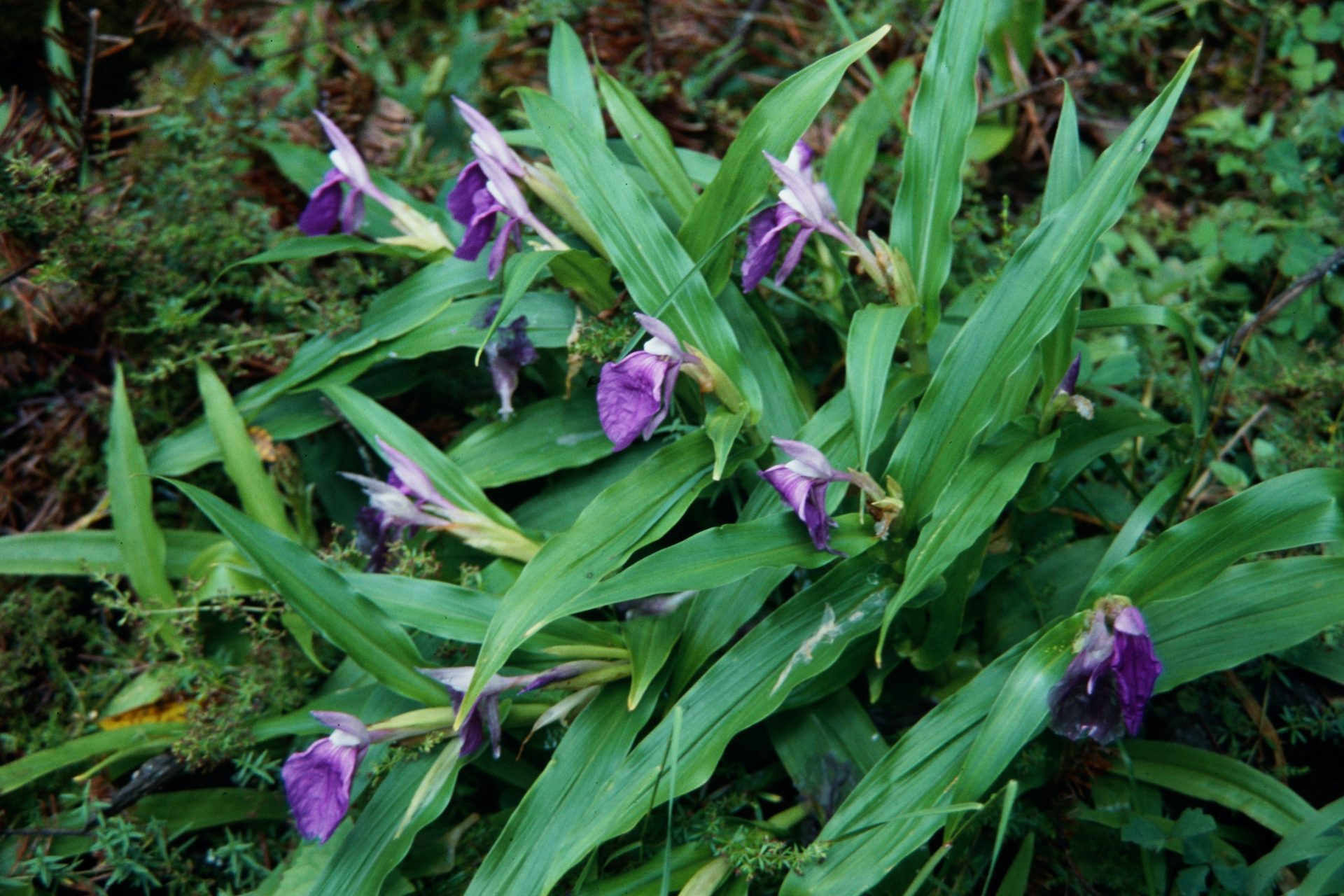
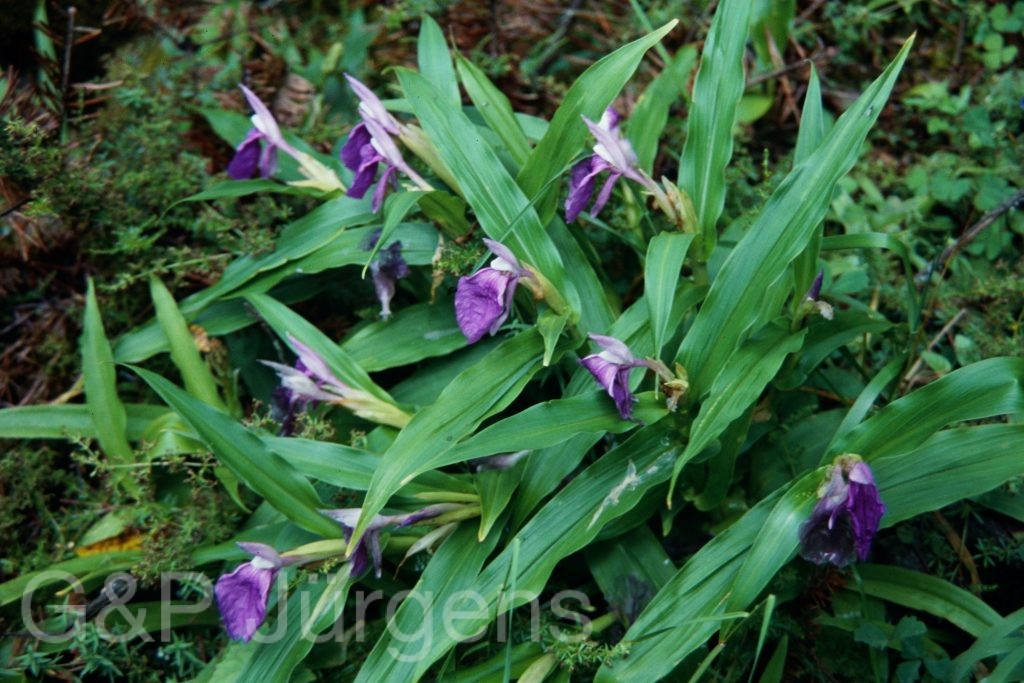
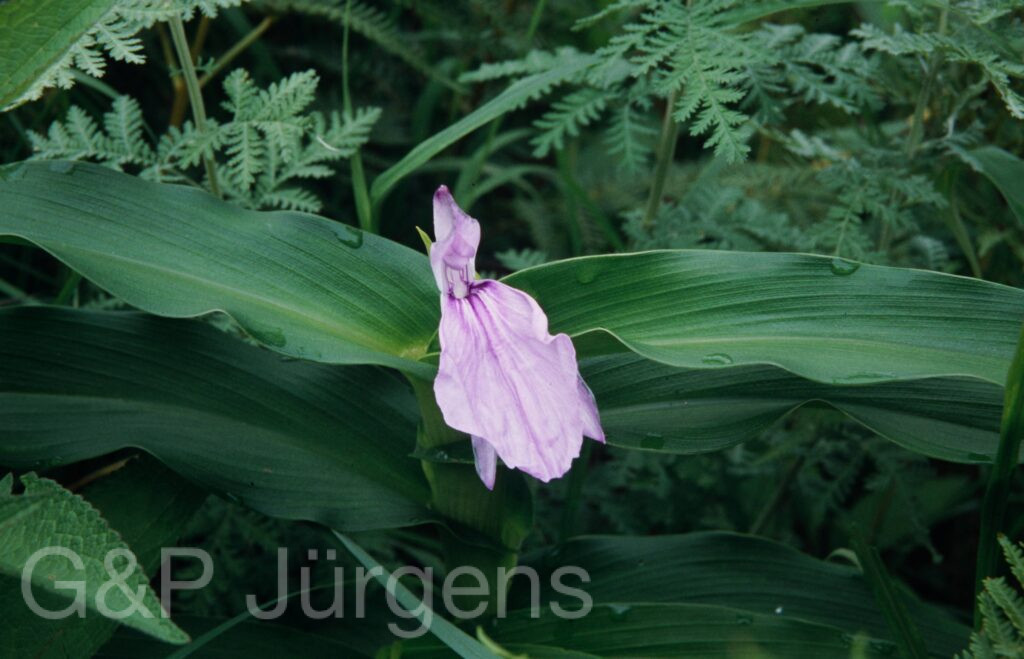
Roscoea auriculata is an eastern Himalayan terrestrial ginger recorded from India, China, Nepal and Bhutan across some 126 GBIF occurrences. The photographed plants were found above Yoksam in Sikkim at 2200 m in August and at Hanke in West Nepal at 2700 m in July, locations typical of its range in moist temperate forest glades, grassy banks and open slopes between roughly 2000 and 3000 m. Unlike most members of the predominantly tropical Zingiberaceae, Roscoea is adapted to cool montane conditions, dying back to a tuberous rootstock to overwinter and emerging with the summer monsoon.
The plant is an erect perennial herb arising from clustered fleshy, tuberous roots. The leaves are few, lanceolate and arranged distichously, their sheaths forming a false stem (pseudostem); the diagnostic feature signalled by the epithet is the conspicuously auriculate leaf-sheath base. The flowers are large, showy and orchid-like, deep violet to purple, emerging successively from a terminal cluster; each has a hooded dorsal corolla lobe, two erect lateral staminode-like structures and a broad, often bilobed reflexed labellum, with a single fertile stamen.
Note that the input family is given as "Zingiberacaea", an evident misspelling of Zingiberaceae, in which Roscoea is correctly placed. The genus is celebrated for its convergence on an orchid-like floral form, an adaptation for pollination by long-tongued bees, and is much prized in cultivation for hardy temperate gardens. R. auriculata has a relatively restricted eastern Himalayan distribution; though not formally threatened, it is locally collected and sensitive to habitat disturbance.
Author: K.Schum. · Sources: POWO (Kew), GBIF, Flora of Bhutan, Flora of Nepal, Flora of China, Cowley – The Genus Roscoea (Royal Botanic Gardens Kew monograph)