
Royle ex Benth.
Description
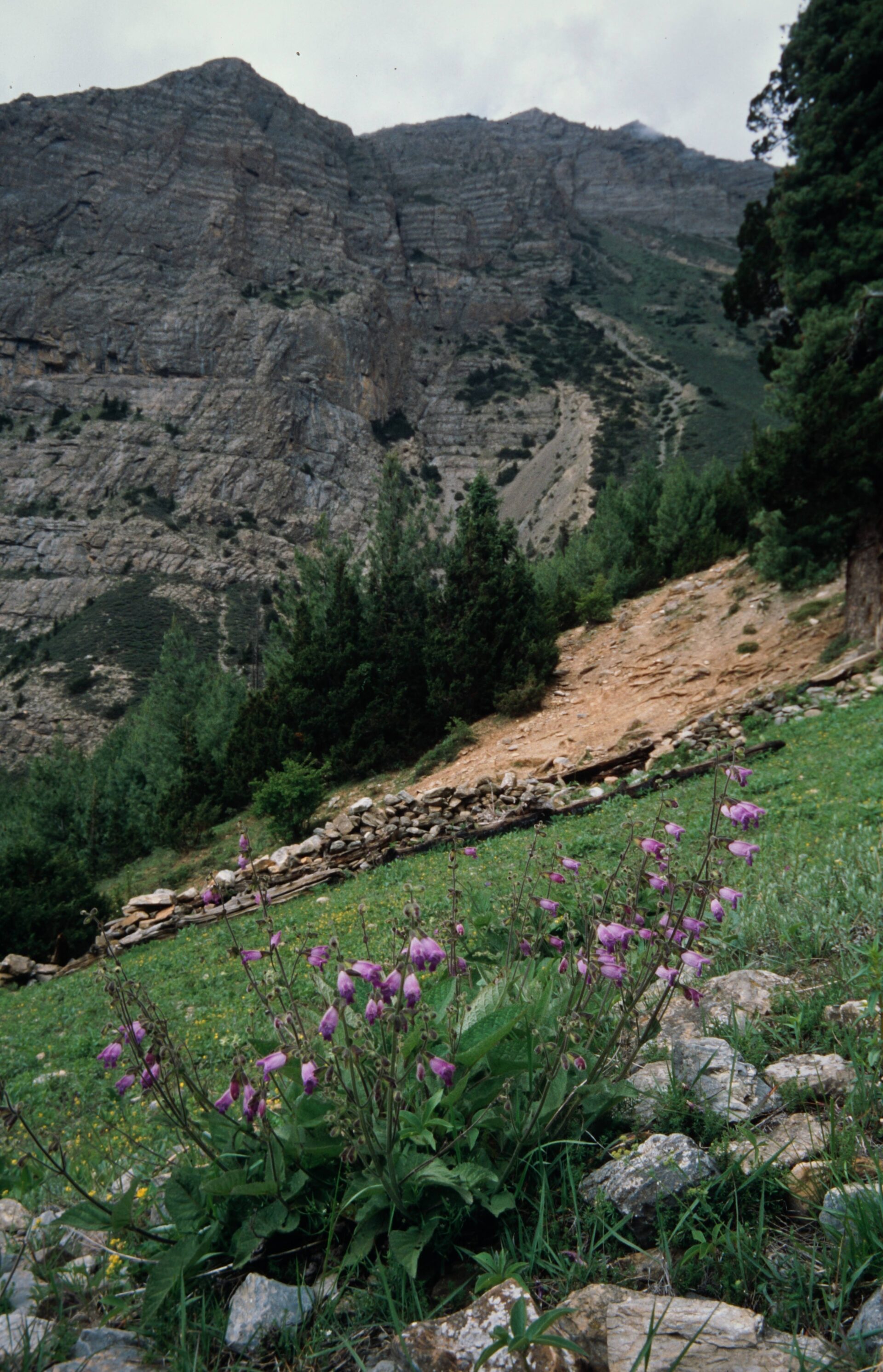
Salvia hians is a Himalayan herbaceous perennial of the temperate to subalpine belt of the western and central Himalaya, with occurrences in India, Nepal, Pakistan and adjacent China; its c. 217 georeferenced records (further reports from Europe and North America reflect cultivated material). It favours open grassy slopes, forest margins, alpine meadows and moist rocky banks, typically between 2400 and 4000 m. The photographed plant from the Sanu Bheri valley in West Nepal at 3500 m, flowering in July, is characteristic of its summer-flowering subalpine habitat among tall herbs in the monsoon-watered turf.
It forms an erect, somewhat sticky-pubescent herb 30-90 cm tall arising from a stout rootstock, with mostly basal, long-petioled, ovate-cordate leaves bearing crenate to doubly serrate margins and a rugose surface. The inflorescence is a lax terminal raceme of distant verticillasters. The corolla is showy, c. 3-5 cm long and deep violet-blue to purple, conspicuously bilabiate with a strongly hooded, gaping (hence "hians") upper lip and a broad lower lip. The calyx is bell-shaped and two-lipped, and the two fertile stamens bear the characteristic lever mechanism of Salvia. The fruit comprises four smooth ovoid nutlets enclosed in the persistent calyx.
Described by Royle ex Bentham, S. hians belongs to the large, near-cosmopolitan genus Salvia, the most species-rich genus of Lamiaceae, and represents the showy Himalayan element of the subgenus Sclarea-group. The flowers are pollinated by long-tongued bees and bumblebees exploiting the staminal lever. Locally the species enters folk medicine and is occasionally grown ornamentally. It remains widespread and is not currently regarded as threatened, though habitat degradation through grazing and tourism affects some populations.
Author: Royle ex Benth. · Sources: POWO (Kew), GBIF, Flora of Nepal, Flora of Pakistan, Flora of China, Hedge's revision of Himalayan Salvia (Lamiaceae)