
Hook. f.
Description
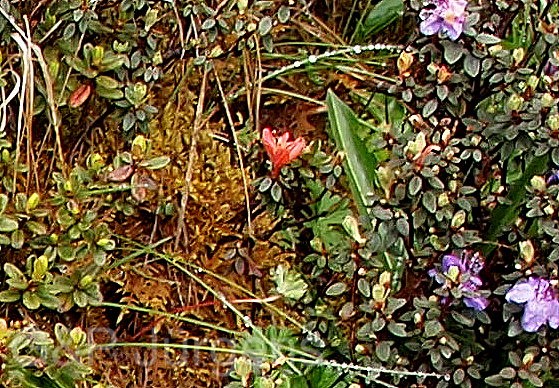
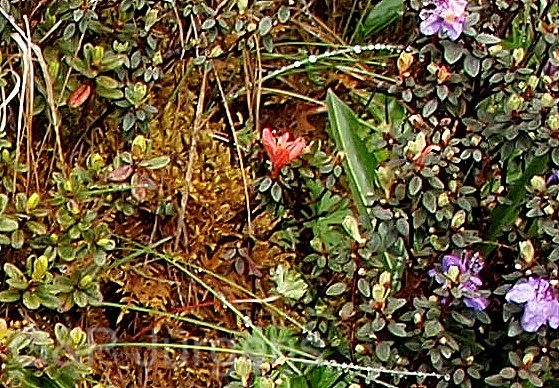
Rhododendron pumilum is a diminutive alpine shrublet of the eastern Himalaya and adjacent Sino-Himalayan region, recorded from China (Tibet, Yunnan), Nepal, India, Bhutan and Myanmar, with 115 georeferenced occurrences. It inhabits the high alpine zone, growing in damp turf, on mossy rocks, peaty banks and the margins of snow-fed meltwater seeps, typically between about 3500 and 4800 m. The species was photographed on the Ludlow-Sherriff Trail near Dem-Tso, Bhutan, at 4700 m in July, an elevation reflecting its strong association with the uppermost alpine meadows and moist micro-sites close to the limit of vascular plant growth.
It is one of the smallest rhododendrons, a creeping, mat-forming evergreen rarely more than 8 to 15 cm tall, with slender prostrate stems rooting at the nodes and minutely scaly young growth. The tiny leaves are obovate to elliptic, leathery, lepidote beneath with pale scales and often slightly revolute at the margin. The flowers are borne singly or in pairs at the shoot tips on relatively long pedicels and are nodding, broadly campanulate and pink to rose-purple, comparatively large in proportion to the plant; the stamens are typically ten and the style short and stout. The fruit is a small scaly capsule.
The species is placed in Rhododendron subgenus Rhododendron, section Rhododendron (subsection Uniflora), a group of cushion-forming dwarf lepidote species of the high Sino-Himalaya. Its solitary nodding flowers and creeping habit distinguish it from related dwarfs. Ecologically it is a specialist of cold, moist, well-aerated alpine substrates and an associate of cushion-plant communities. Though not assessed as globally threatened, its restriction to narrow high-elevation habitats makes it vulnerable to climate-driven habitat contraction.
Author: Hook. f. · Sources: POWO (Kew), GBIF, Flora of Bhutan, Flora of China, The Genus Rhododendron (Cullen & Chamberlain monograph)