
D.Don
Description
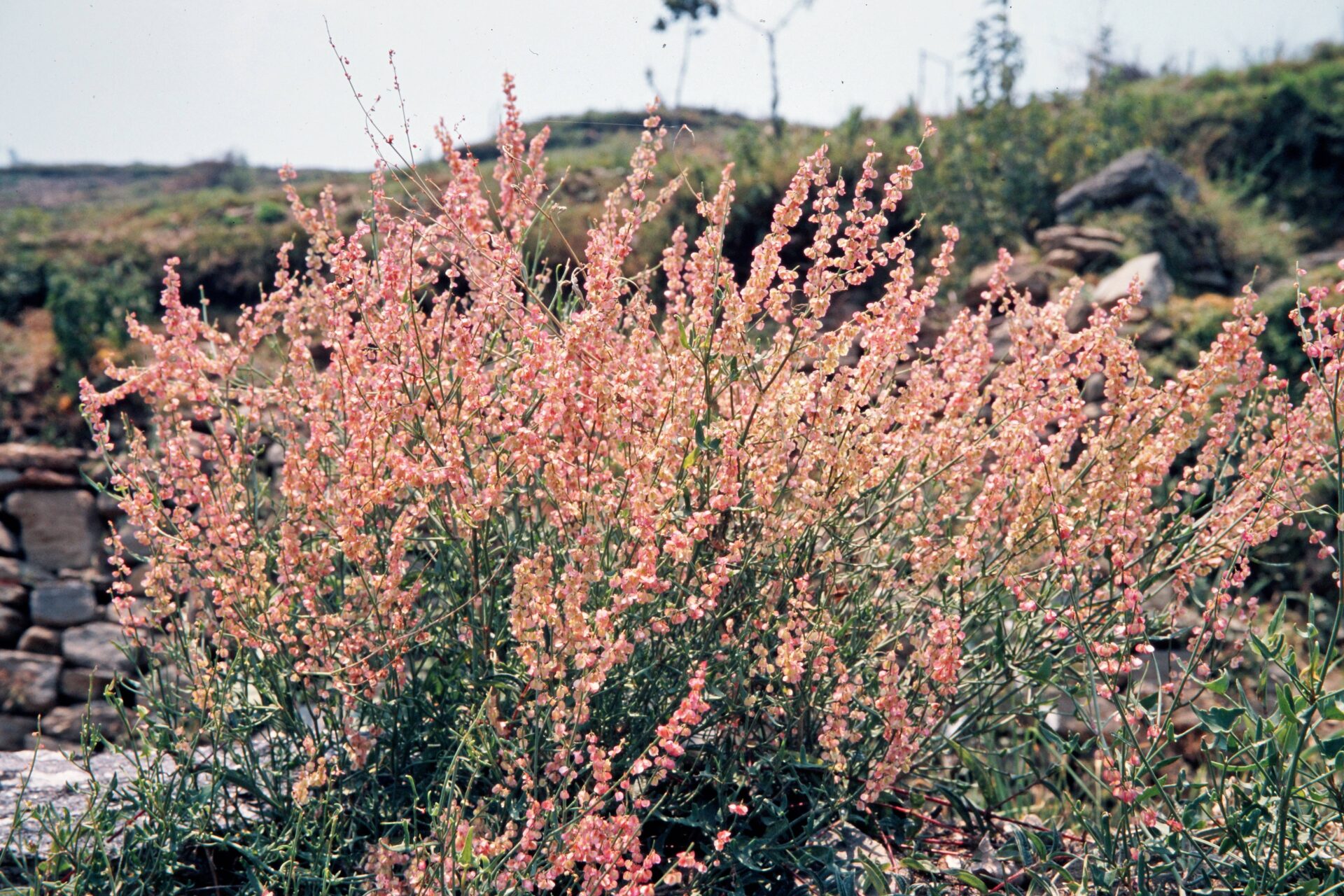
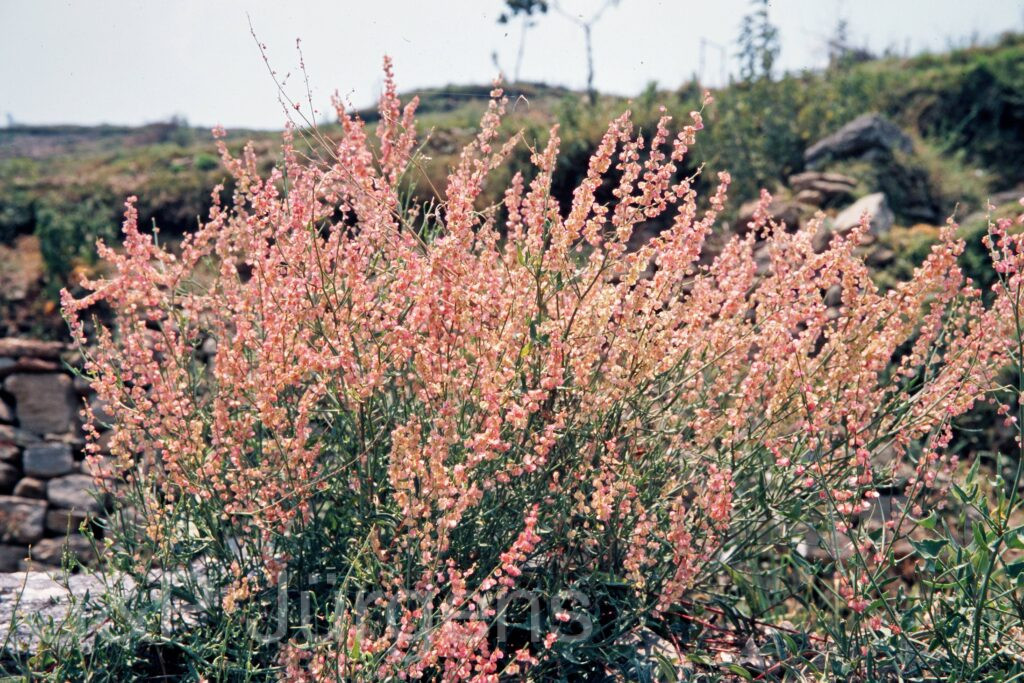
Rumex hastatus is a widespread sub-shrubby dock distributed across the Himalaya and adjacent uplands, with GBIF documenting some 756 occurrences spanning China, India, Pakistan, Nepal, Afghanistan, Bhutan and Myanmar, alongside scattered introduced records in New Zealand and North America that mark it as a casual alien beyond its native range. It is a colonist of dry, sunny, often disturbed ground: rocky banks, terraced field margins, road cuttings, riverine gravels and open hillsides, ranging from around 700 m to over 3000 m. The plant photographed at Sana on the Mandakini in Garhwal, India, at about 1750 m in June, represents a typical warm-temperate montane locality where the species forms conspicuous reddish-tinged stands on stony slopes.
Morphologically it is a much-branched, woody-based perennial or subshrub reaching 30 to 100 cm, the slender intricate branches glabrous and often reddish. The leaves are characteristically hastate, the small narrow blade bearing a pair of spreading basal lobes, hence the epithet; lower leaves may be obovate, and the foliage is somewhat fleshy and grey-green. As in all Rumex the stem is sheathed at the nodes by membranous ochreae. The inflorescence is a large, lax, much-branched terminal panicle of small dioecious or polygamous flowers. The fruiting perianth develops three enlarged, rounded, membranous and often rose-tinted inner valves (wings) without conspicuous tubercles, enclosing a small trigonous brown nutlet and aiding wind dispersal.
The species sits within Rumex subgenus Acetosa, the sorrels, distinguished by their hastate or sagittate leaves, sour oxalate-rich sap and unisexual flowers. R. hastatus is valued locally as a pot-herb and in traditional medicine, the acidic foliage used as a refreshing condiment and astringent. Ecologically it is a hardy pioneer of degraded and eroding substrates, tolerant of drought and grazing, which underlies both its abundance throughout the Himalayan foothills and its capacity to naturalise elsewhere. It is of no conservation concern, being common and adaptable across a broad altitudinal and geographic span.
Author: D.Don · Sources: POWO (Kew), GBIF, Flora of China Vol. 5, Flora of Pakistan, Flora of Nepal, Rechinger Monograph of Rumex