
H.Hara
Description
Primula megalocarpa H.Hara is a high-alpine primula of the eastern and central Himalaya, recorded from Nepal, Bhutan, northern India and south-western China, with around 109 georeferenced occurrences in GBIF. It inhabits open alpine turf, moist rocky slopes, moraine and the margins of late-lying snowbeds, generally between about 3800 and 4800 m. The collection cited from the Ludlow-Sherriff trail at Laden-Tso at 4300 m in July is typical of its ecology, flowering as the snow retreats in habitats kept cool and damp by glacial meltwater and frequent cloud.
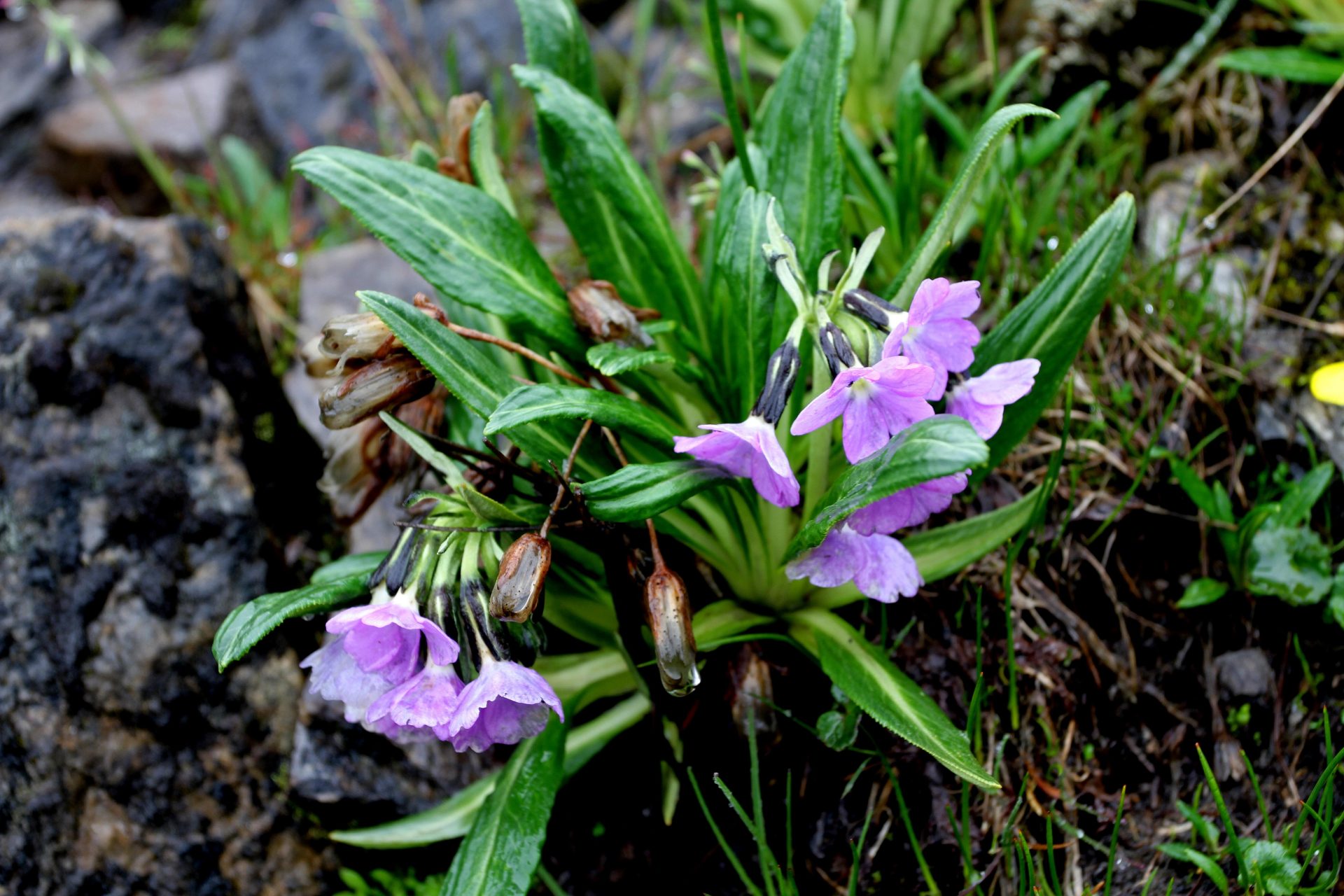
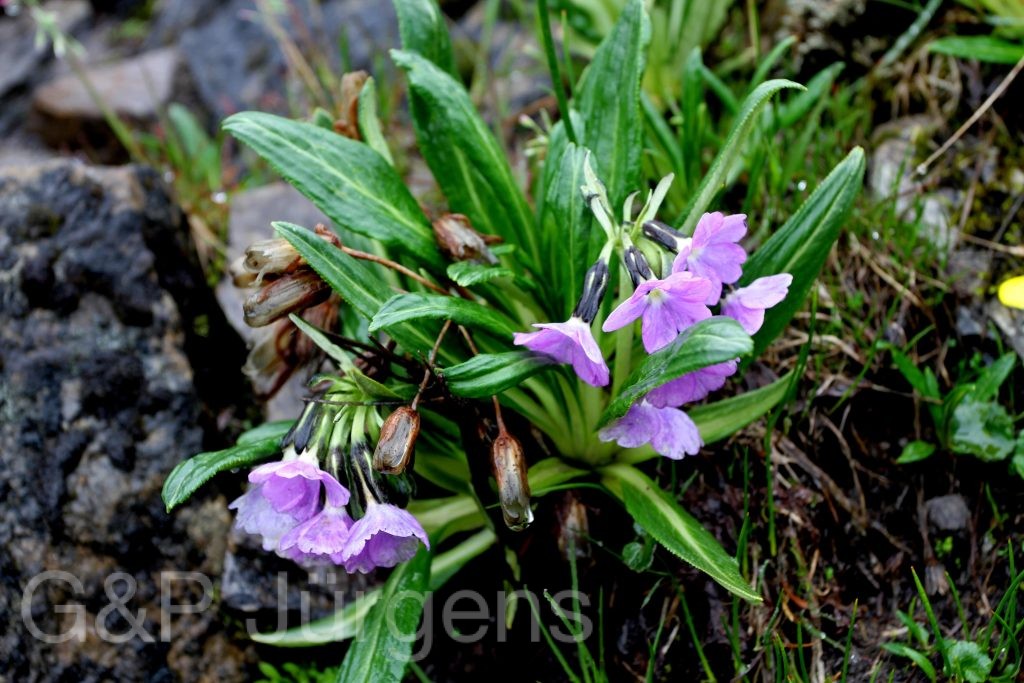
It is a small farinose perennial forming a compact rosette from a slender rootstock. The leaves are obovate to oblanceolate, narrowed to a winged base, with a finely toothed margin and a white- or yellow-farinose lower surface. Short scapes carry one to few violet to purple, flat-faced flowers; the corolla lobes are obcordate and notched, surrounding a farinose eye, and the calyx is farinose and lobed to about the middle. As the epithet megalocarpa implies, the species is notable for its conspicuously enlarged capsule, which is ovoid and considerably exceeds the calyx at maturity, a feature that readily separates it from related dwarf alpine species.
The enlarged fruit places it among the small-flowered cushion-forming primulas of section Minutissimae and allied groups, where it is distinguished chiefly by capsule size and farina distribution. Like many nival primulas it is tied to a narrow alpine belt and dependent on reliable snow cover, making such species sensitive indicators of shifting snowlines. No conservation status has been published, but its high-altitude niche warrants monitoring.
Author: H.Hara · Sources: POWO (Kew), GBIF, Flora of Bhutan, Flora of China, Smith & Fletcher monograph of Primula