
Georgi

Description
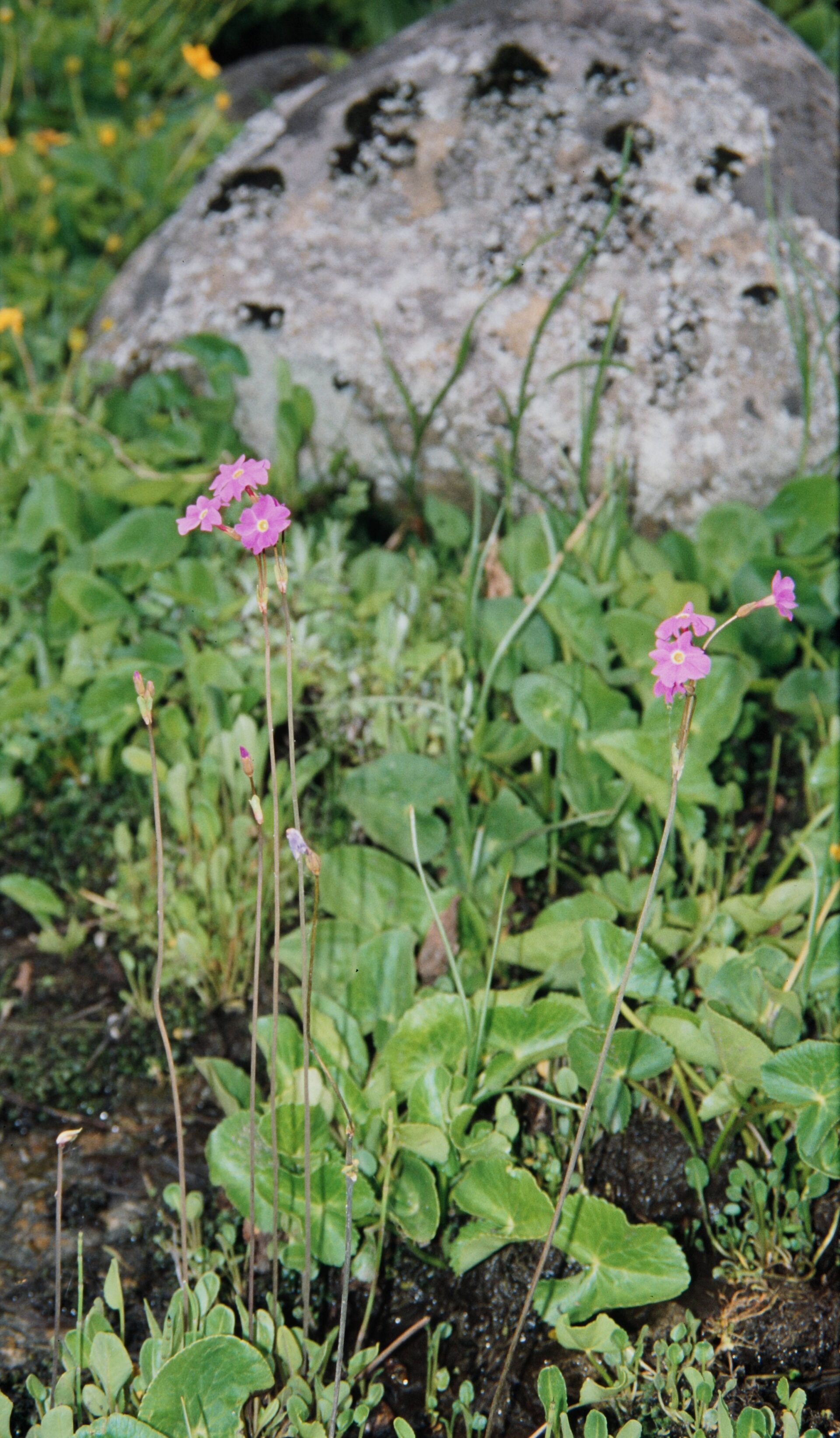
Primula nutans Georgi is a circumboreal to continental Asian perennial with one of the broadest ranges in the genus, the GBIF dataset listing more than 11,700 occurrences across Fennoscandia (Finland, Sweden, Norway, Denmark), Russia, Greenland, North America (Canada, United States), Central Asia (Kazakhstan, Kyrgyzstan, Tajikistan, Mongolia) and into China, with disjunct southern records reaching India and Nepal. It is a plant of moist, often saline or calcareous habitats: coastal meadows, lake and river shores, damp turf, marshy flushes and seepage slopes. The illustrated material from the Chautabise-Khola in west Nepal at 2800 m in June represents the species near the southern, montane edge of its enormous Holarctic distribution, where it persists in damp grassy ground.
It is a small, glabrous perennial herb arising from a slender rootstock, lacking the farinose (mealy) covering of many congeners. The leaves form a basal rosette and are oblong to spatulate or elliptic, entire to faintly toothed, narrowing into a winged petiole. From the rosette rises a slender, leafless scape bearing a terminal umbel of a few nodding flowers, the nodding habit giving the epithet nutans. Each flower has a tubular, five-lobed calyx and a salverform corolla of pink to lilac-purple with a yellow eye, the lobes shallowly notched. The species is typically homostylous in many populations. The fruit is a cylindrical to ovoid capsule that opens by apical valves to shed numerous small seeds.
Primula nutans belongs to section Armerina, a group of small, often coastal or wetland primulas with farina-free foliage and nodding flowers, and has at times been treated under the names P. sibirica or P. finmarchica, reflecting taxonomic revision of this widespread aggregate. Its tolerance of saline and seasonally flooded ground is ecologically distinctive within the genus. Although globally secure given its vast range, peripheral and lowland populations, particularly along Baltic and Arctic coasts, are vulnerable to habitat loss, drainage and shoreline development, and are locally protected.
Author: Georgi · Sources: POWO (Kew), GBIF, Flora of China, Flora Nordica, John Richards – Primula (monograph)