
(Bureau & Franch.) Pinto-Carr., E.Rico & M.M.Mart.Ort.
Description
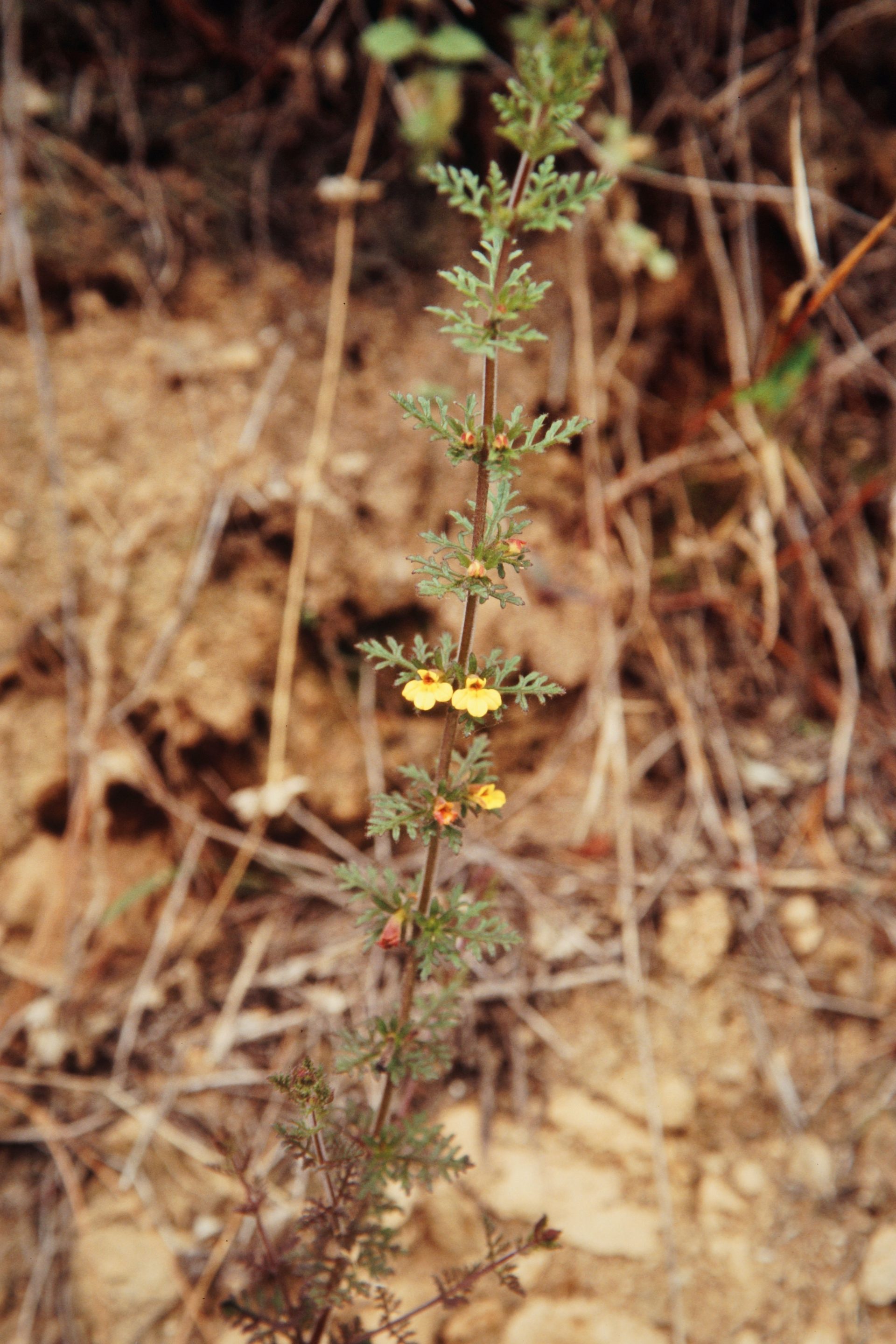
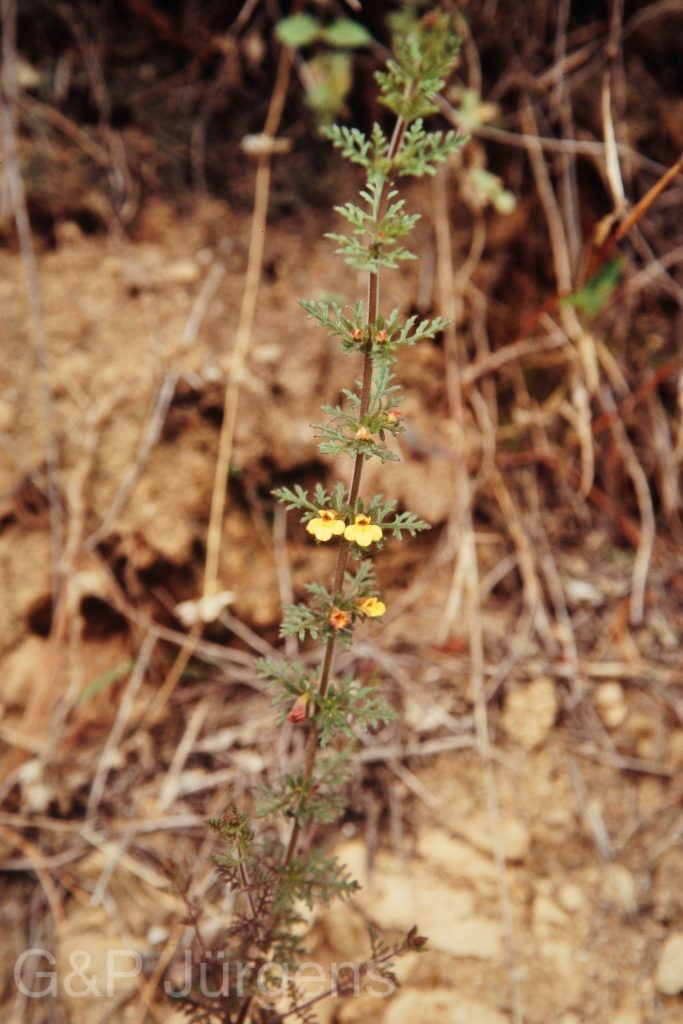
Pterygiella tenuisecta (Bureau & Franch.) Pinto-Carr., E.Rico & M.M.Mart.Ort. is a hemiparasitic annual herb of the Sino-Himalayan region, distributed through Bhutan, northern India and south-western China (notably Yunnan and Sichuan), with the GBIF dataset of roughly 883 occurrences also carrying determinations referable to material in Japan. Often treated under the name Phtheirospermum tenuisectum, it occupies open grassy slopes, forest margins, scrub and disturbed banks at montane elevations, where like other root-hemiparasites it attaches to the roots of neighbouring grasses and herbs while retaining functional green foliage. The illustrated plant was photographed at Paro in western Bhutan at around 2500 m in June, an elevation and season typical of its flowering in the temperate montane belt.
It is a slender, erect to ascending annual with branched, glandular-pubescent stems. The leaves are opposite below and may become alternate above, the blades pinnatisect to bipinnatisect with narrow, almost filiform ultimate segments, giving the foliage a finely divided, feathery appearance reflected in the epithet tenuisecta. The flowers are solitary in the upper leaf axils, shortly pedicellate, with a tubular, ribbed, glandular calyx of fused sepals. The corolla is yellow, two-lipped, the upper lip hooded and the lower three-lobed and spreading, enclosing four didynamous stamens. The fruit is a loculicidal, ovoid to oblong capsule containing numerous small seeds.
The species has been shuttled between several genera of the broomrape family, having been described in Gerardia and later placed in Phtheirospermum before molecular and morphological work supported its transfer to Pterygiella; the synonymy underlies the differing names on the source page. As a facultative hemiparasite it plays a part in regulating grassland community structure, drawing water and nutrients from hosts while contributing its own photosynthesis. No conservation concern is recorded, the plant being a widespread component of seasonally moist montane grasslands across its Sino-Himalayan range.
Author: (Bureau & Franch.) Pinto-Carr., E.Rico & M.M.Mart.Ort. · Sources: POWO (Kew), GBIF, Flora of China, Flora of Bhutan, Orobanchaceae phylogenetic studies (Pinto-Carrasco et al.)