
(Buch.-Ham.) Pennell
Description
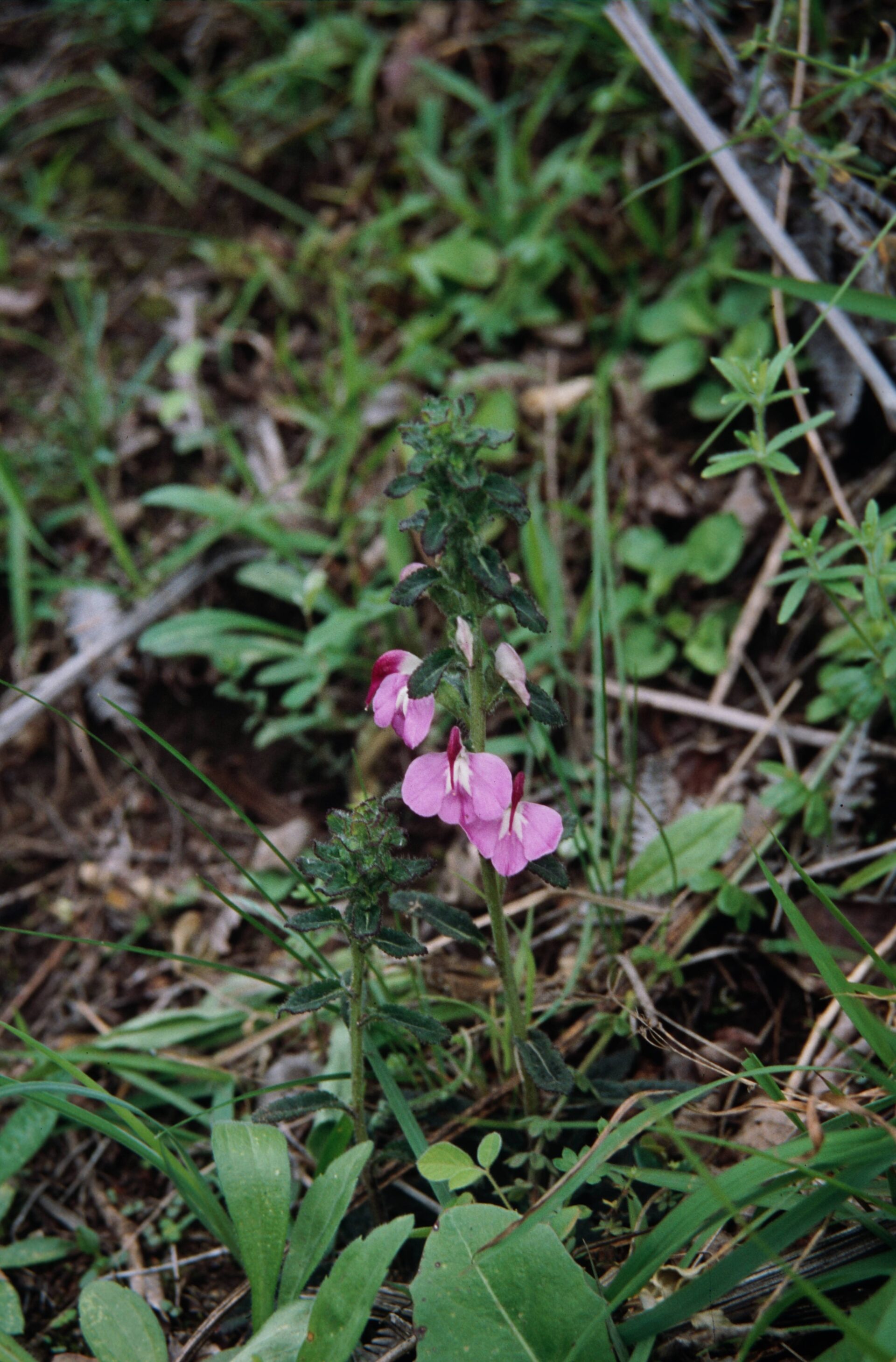
Pedicularis bifida is a hemiparasitic perennial herb of the temperate and subalpine Himalaya, distributed through Nepal, India, Bhutan, China and Myanmar across some 250 documented records. It grows in moist meadows, forest clearings, shrubberies and along streamsides, generally between 2400 and 3800 m, flowering with the summer monsoon. The illustrated plant was collected at Sepka in West Nepal at 2700 m in July, within the typical mid-montane band where the species is most frequently encountered among tall-herb vegetation.
Like all lousewort, the plant is a root-parasite drawing water and nutrients from neighbouring hosts via haustoria. It forms erect, sometimes branched stems clothed with alternate to subopposite, pinnately lobed leaves bearing toothed segments. The flowers are aggregated into terminal leafy-bracted spikes or racemes; the calyx is tubular and toothed, and the strongly zygomorphic corolla is pink to rose-purple with a tube and a galeate upper lip whose apex is conspicuously bifid or beaked, the feature giving the epithet, and a spreading three-lobed lower lip. The four didynamous stamens lie within the galea and the fruit is an oblique, beaked loculicidal capsule.
The genus Pedicularis, transferred from Scrophulariaceae to Orobanchaceae on molecular grounds, reaches extraordinary diversity in the Sino-Himalaya, where elaborate corolla architecture promotes specialised pollination by long-tongued bumblebees. The bifid galea of this species reflects such floral specialisation. As a widespread, locally common meadow component, P. bifida is not considered threatened, though it depends on intact host-rich grassland communities.
Author: (Buch.-Ham.) Pennell · Sources: POWO (Kew), GBIF, Flora of China, Annotated Checklist of the Flowering Plants of Nepal, Flowers of the Himalaya, Prain & Pennell revisions of Pedicularis