
(Hook. f.) Grierson
Description
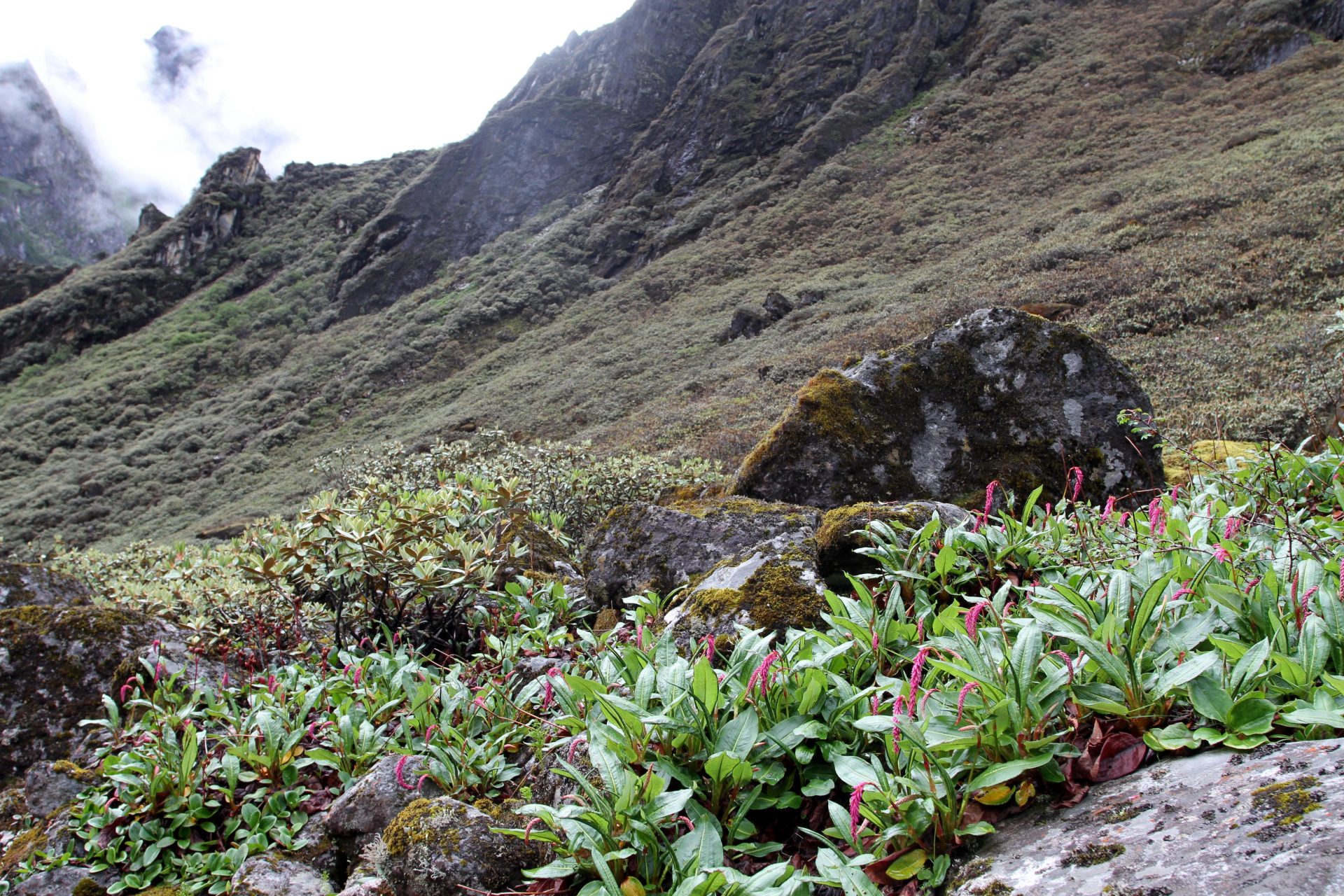
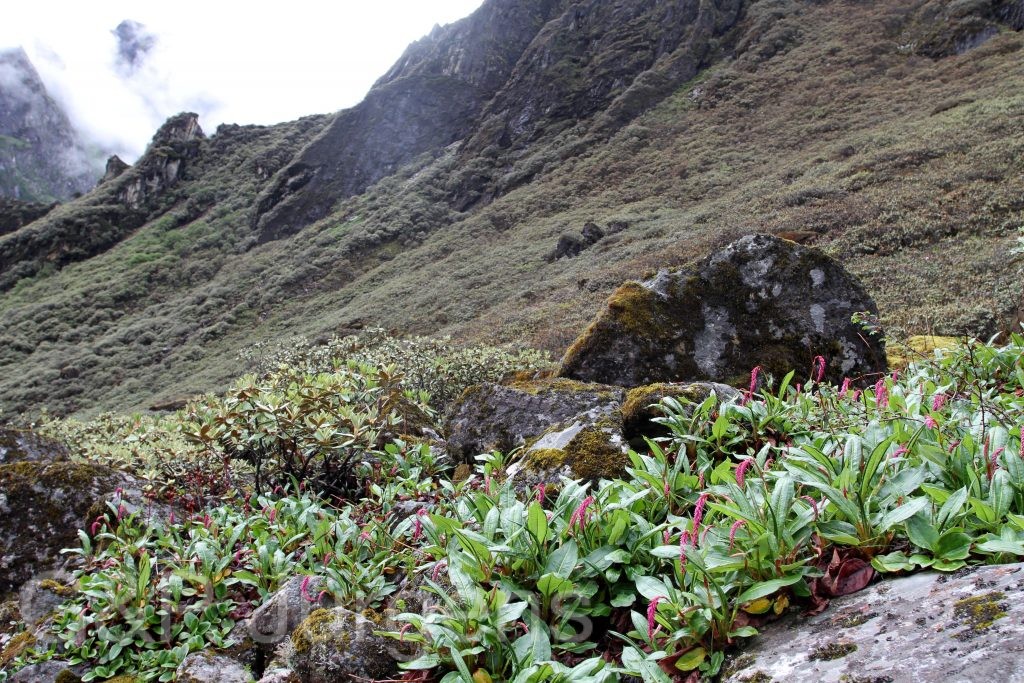
Bistorta griffithii (Hook. f.) Grierson is an alpine perennial herb of the eastern Himalaya, ranging through Bhutan, Sikkim and northern India into south-western China (Xizang, Yunnan) and northern Myanmar; the GBIF record of around 176 occurrences also includes herbarium-based citations from the United Kingdom and the United States. It is a plant of high alpine meadows, damp turf, rocky slopes and the upper margins of Rhododendron scrub, favouring cool, moisture-retentive soils kept wet by snowmelt and monsoon mist. The illustrated material was gathered along the Ludlow-Sherriff Trail at Mangde-Chu in central Bhutan at 3950 m in July, typical of the short midsummer flowering window in the upper alpine zone where this species reaches its display.
The plant arises from a short, thick, somewhat woody and contorted rhizome, producing erect, simple, unbranched stems. Basal leaves are long-petiolate with ovate to lanceolate or oblong blades, the margins entire and the lower surface often paler or thinly hairy; cauline leaves are few, smaller and shortly petiolate to sessile, subtended by membranous, tubular ochreae characteristic of the family. The inflorescence is a solitary, dense, terminal cylindrical to oblong spike of small flowers; perianth segments are five, white to pale pink, with eight stamens and a trifid style. As in many bistorts the lower flowers may be replaced by reddish bulbils. The fruit is a small, trigonous, dark brown shining achene enclosed by the persistent perianth.
Formerly placed in the broadly circumscribed genus Polygonum, this species is now treated in Bistorta on the basis of its perennial habit, unbranched flowering stems and dense terminal spikes. It is closely allied to other Himalayan bistorts such as B. macrophylla and B. vivipara, from which it is distinguished by leaf shape and inflorescence characters. Ecologically it contributes to the herbaceous turf grazed by livestock and wild ungulates, and the production of bulbils provides an effective means of vegetative propagation in the short, harsh alpine growing season. It has not been formally assessed for conservation but appears locally frequent within suitable habitat.
Author: (Hook. f.) Grierson · Sources: POWO (Kew), GBIF, Flora of Bhutan, Flora of China, Polygonaceae monograph (Hong & Steward)