
(Lour.) Merr.
Description
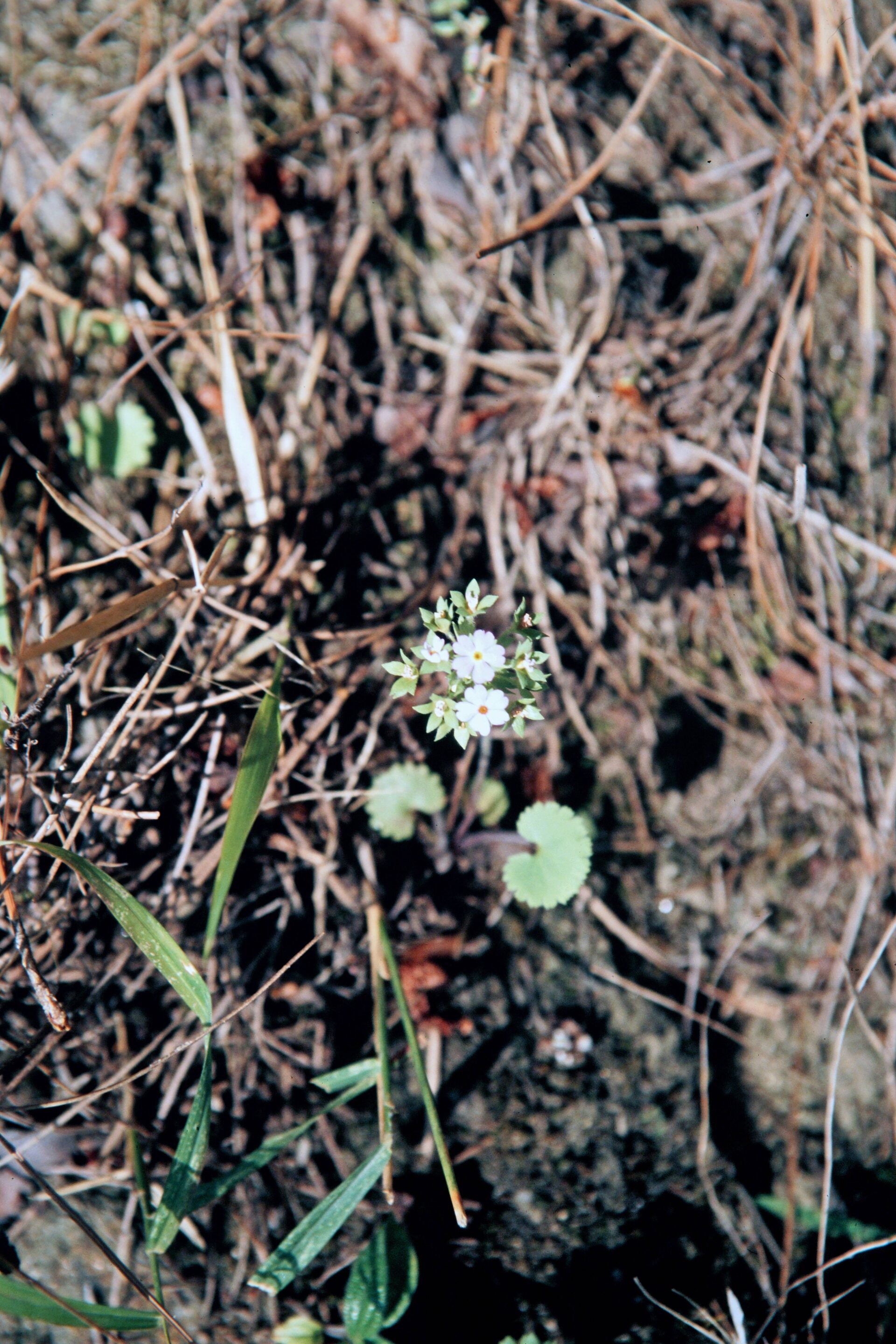
Androsace umbellata is a widespread East and South Asian annual ranging from the Himalaya across China, Korea, Japan, Taiwan and Southeast Asia to the Russian Far East; GBIF documents over 4000 occurrences, reflecting its abundance and broad ecological tolerance. It is a plant of open, disturbed and grassy ground, occurring on banks, terraces, field margins, roadsides, lawns and forest clearings from the foothills into the lower temperate zone. The image from Ransi by the Mandakini in Garhwal (India) at about 1850 m in June shows it in a typical mid-montane setting, where it forms scattered rosettes on moist, sunny slopes early in the growing season.
It is a small, soft, hairy annual herb forming a basal rosette of leaves close to the ground. The leaves are broadly ovate to orbicular or suborbicular, shallowly toothed to crenate at the margin, narrowed to a winged petiole and clothed in articulated multicellular hairs. From the rosette arise several slender, leafless scapes bearing terminal umbels of few to several small flowers, each subtended by an involucre of small bracts. The corolla is white, occasionally pinkish, with a short tube, yellow eye and five spreading lobes; the calyx is deeply lobed and accrescent. The fruit is a globose, five-valved capsule containing numerous small, angular brown seeds.
The species belongs to the annual, rosette-forming section of Androsace, contrasting with the perennial cushion species of the high alpine zone. Its weedy, self-compatible annual strategy and prolific seed production underlie its remarkable distribution and frequency in anthropogenic habitats. It is of no conservation concern, being among the commonest lowland and montane androsaces, and is sometimes used in traditional medicine across its East Asian range.
Author: (Lour.) Merr. · Sources: POWO (Kew), GBIF, Flora of China (Primulaceae), Flowers of the Himalaya (Polunin & Stainton), Smith & Lowe monograph of Androsace