
Wall. ex Benth.
Description
Veronica cana is a Himalayan speedwell distributed from Pakistan and northern India (Kashmir to Arunachal Pradesh) through Nepal, Bhutan, and Myanmar to southwestern China (Xizang, Yunnan) and Japan. It occurs in open forest clearings, grassy slopes, rocky banks, and montane scrub at elevations of 1,500–3,500 m. The species has been recorded from the Tolung area in West Bengal at 2,450 m, where it flowers in May during the pre-monsoon season. It favours well-drained, often stony soils in areas receiving moderate to high rainfall.
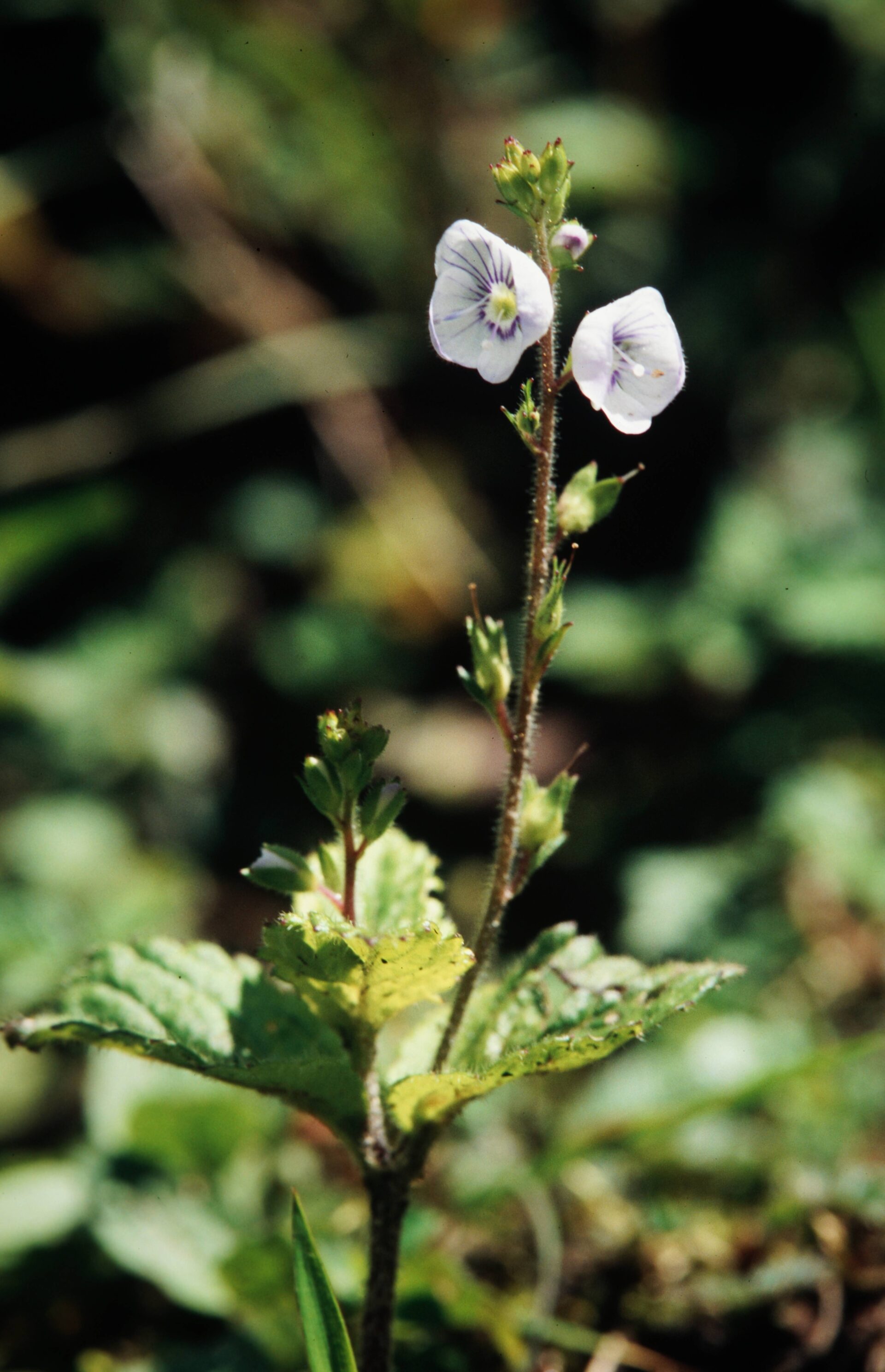
Veronica cana is an erect to ascending perennial herb, 15–40 cm tall, arising from a slender, creeping rhizome. The stems are simple or sparingly branched, densely covered with short, grey-white, appressed hairs that give the plant a characteristically canescent appearance — hence the epithet "cana" (grey-haired). Leaves are opposite, sessile or subsessile, ovate to lanceolate, 2–5 cm long and 1–2 cm wide, with a crenate to serrate margin and dense, soft pubescence on both surfaces. The inflorescence is a terminal raceme, 5–15 cm long, bearing numerous flowers on short, erect pedicels. The corolla is rotate, four-lobed, 5–8 mm in diameter, pale blue to lilac with darker veins. Stamens are two, exserted. The fruit is an obcordate, compressed capsule 3–5 mm wide, emarginate at the apex, containing numerous minute seeds.
Veronica cana belongs to a complex of pubescent, racemose-flowered Himalayan speedwells that have been variously treated taxonomically. Molecular phylogenetic studies have confirmed that Veronica in the broad sense (including former Pseudolysimachion and Veronicastrum segregates) is monophyletic within Plantaginaceae. V. cana is distinguished from the related V. laxa by its denser canescent indumentum and more compact racemes. Ecologically, the species is a characteristic element of Himalayan montane grasslands and forest-edge communities, contributing to ground-layer diversity in habitats increasingly threatened by overgrazing and land-use intensification.
Author: Wall. ex Benth. · Sources: POWO (Kew), GBIF, Flora of China Vol. 18, Flora of Bhutan Vol. 2, Albach et al.: Phylogeny of Veronica (2004)