
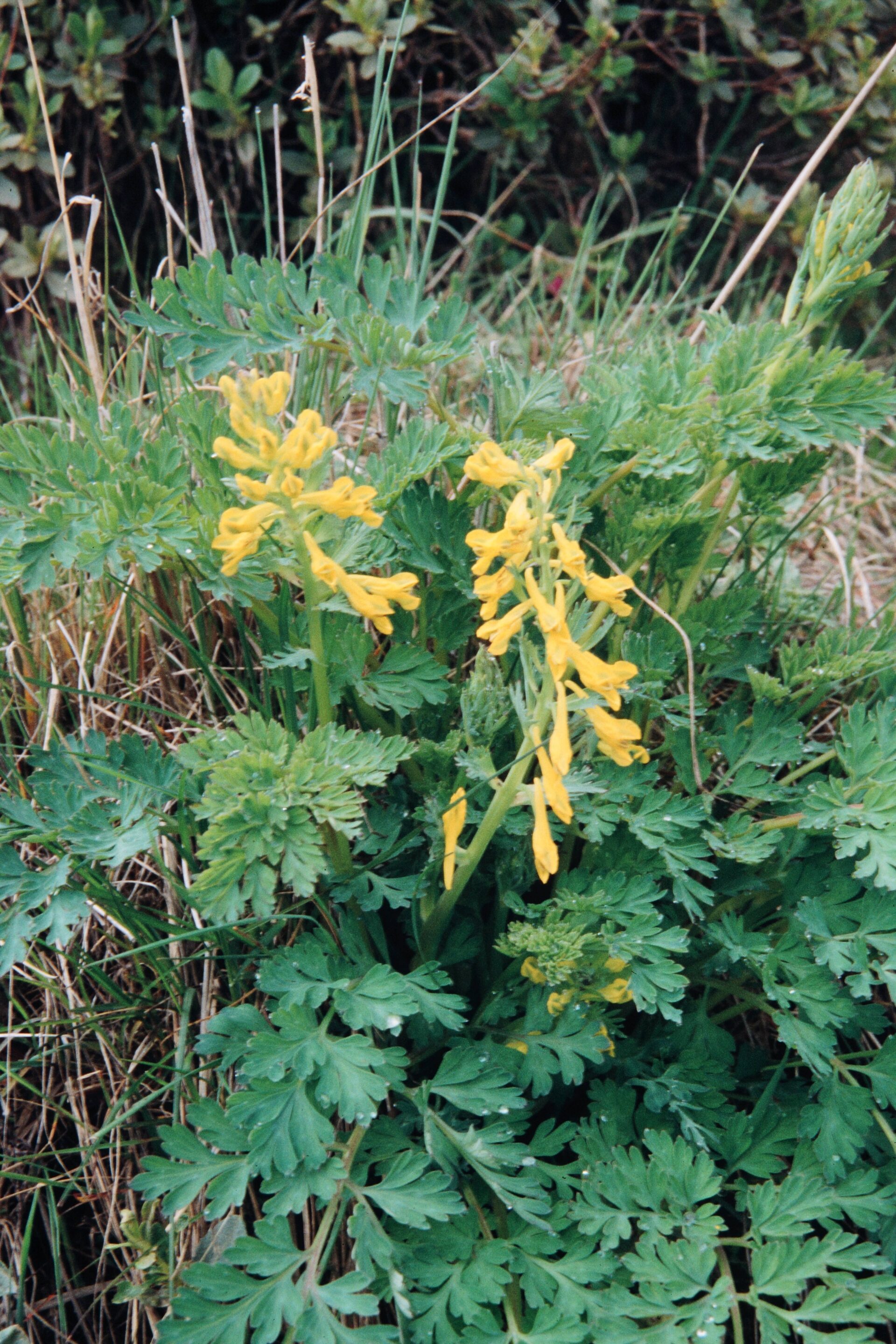
Wall.
Description
Corydalis govaniana is a western and central Himalayan fumitory recorded from India, Nepal, Pakistan and Afghanistan among its roughly 204 occurrences, a distribution centred on the moist temperate and subalpine zones of the inner Himalayan ranges. It grows on shaded forest floors, among rocks, along stream banks and in alpine meadows and scrub where soils are humus-rich and reliably moist. The cited stations span a useful altitudinal range, from Loccu in West Nepal at about 3500 m flowering in June to Baganathi in Garhwal, India, at around 4150 m flowering in September, illustrating its occupancy of the temperate-to-alpine belt and a flowering season that tracks the monsoon up the slope.
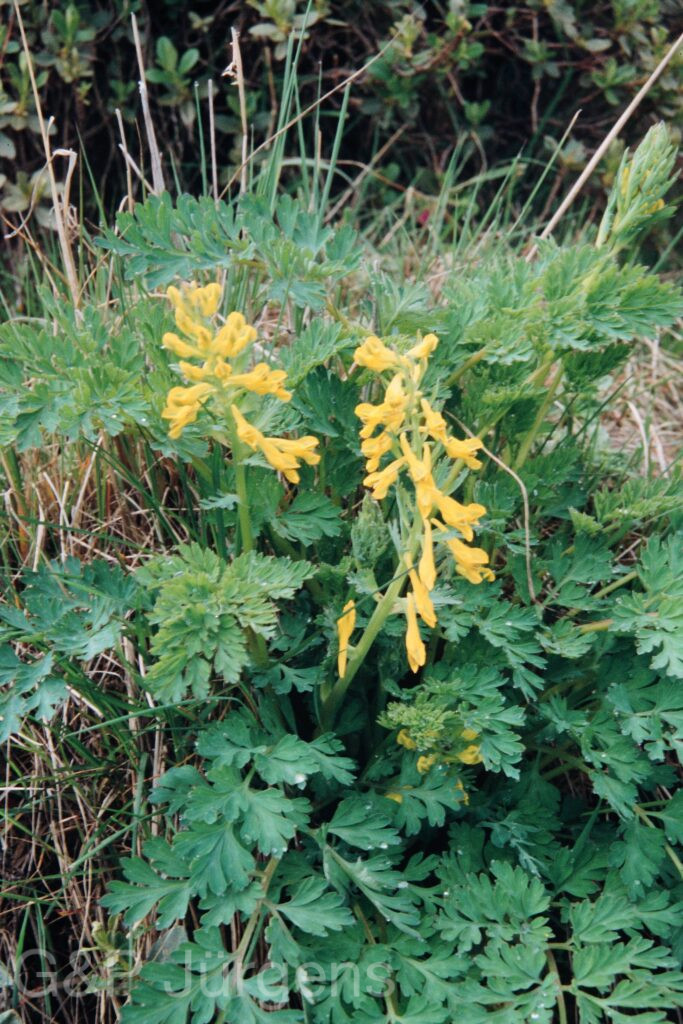
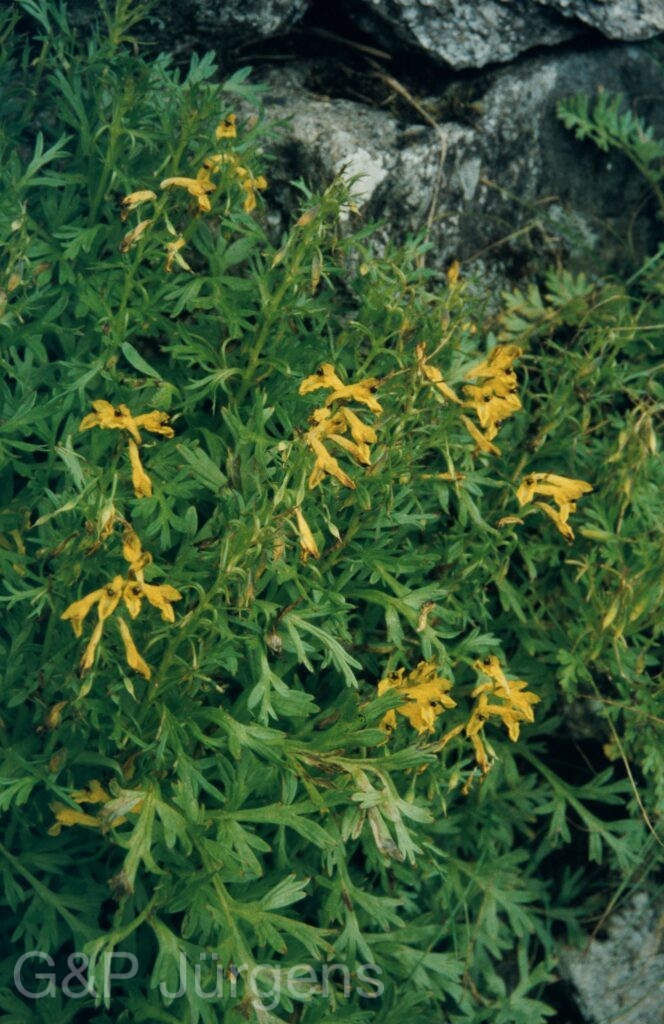
It is a perennial herb arising from a fleshy tuberous or stout fibrous rootstock, with erect to ascending, somewhat glaucous stems. The leaves are alternate and several times pinnately or ternately divided into small, often glaucous, ultimate segments, giving a delicate, ferny aspect. The flowers are borne in terminal racemes and are strongly zygomorphic, each with four petals in two dissimilar whorls; the outer upper petal is prolonged backward into a slender nectar spur, and the colour is yellow, the inner petals often tipped darker. The diandrous androecium has the stamens in two bundles typical of the genus, and the fruit is a slender, dehiscent capsule splitting to release seeds that commonly bear an oil-rich elaiosome.
Corydalis, now placed in Papaveraceae (subfamily Fumarioideae, the segregate Fumariaceae of older treatments), reaches great diversity in the Himalaya and western China, where yellow-flowered species like C. govaniana, an old Wallich name, form a recognisable group distinguished by spur length, bract dissection and tuber form. The elaiosome-bearing seeds are dispersed by ants, a syndrome widespread in the genus. Widely distributed through the western Himalaya and frequent in suitable montane habitat, the species is of no particular conservation concern, though several Himalayan Corydalis are gathered for traditional medicine.
Author: Wall. · Sources: POWO (Kew), GBIF, Flora of Pakistan, Annotated Checklist of the Flowering Plants of Nepal, Flowers of the Himalaya, Lidén and Zetterlund's monograph of Corydalis