
Wall.
Description
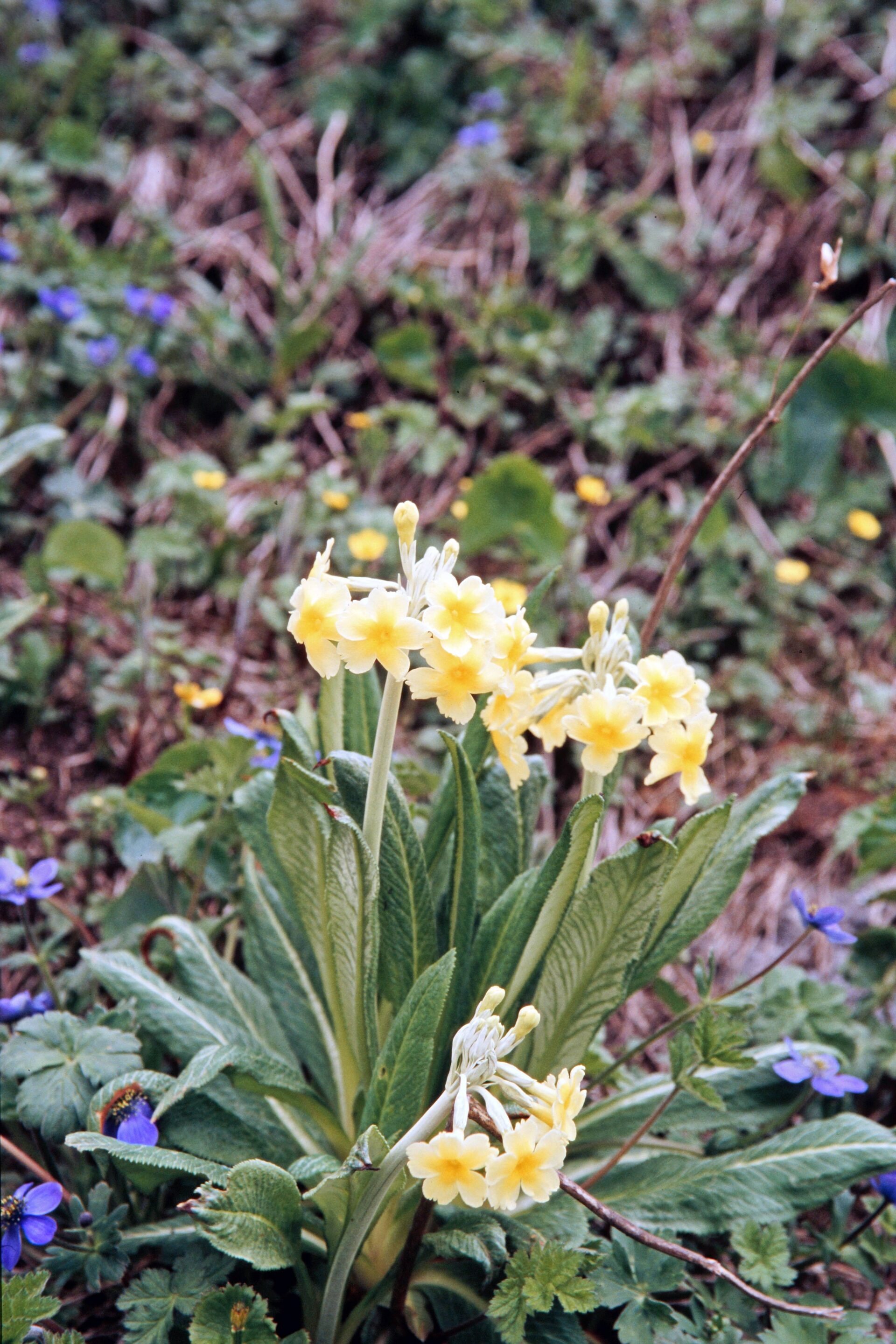
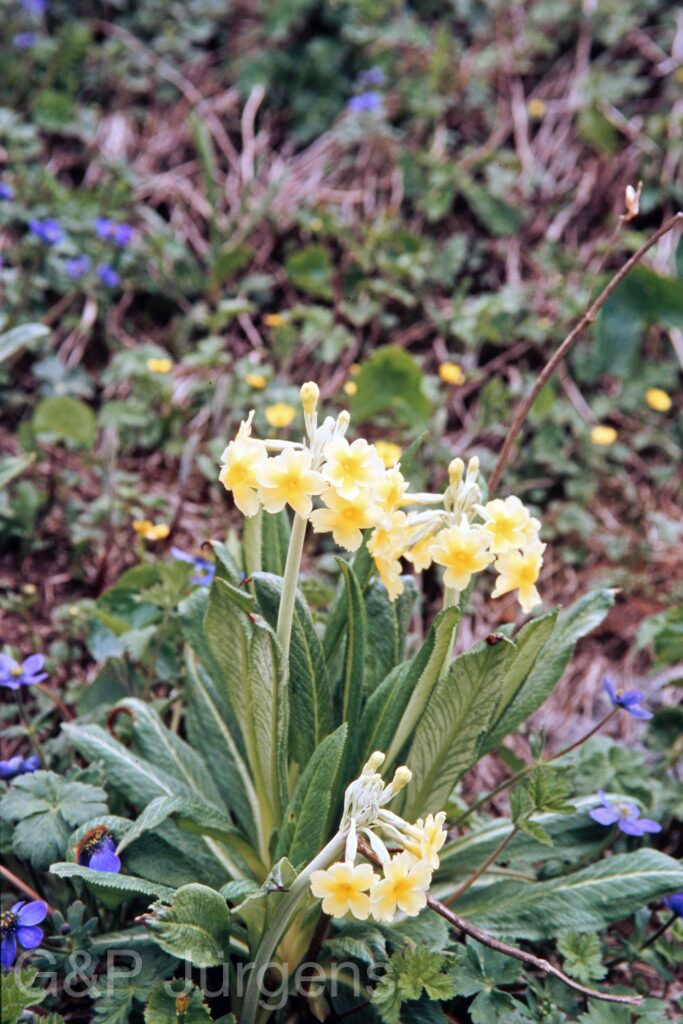
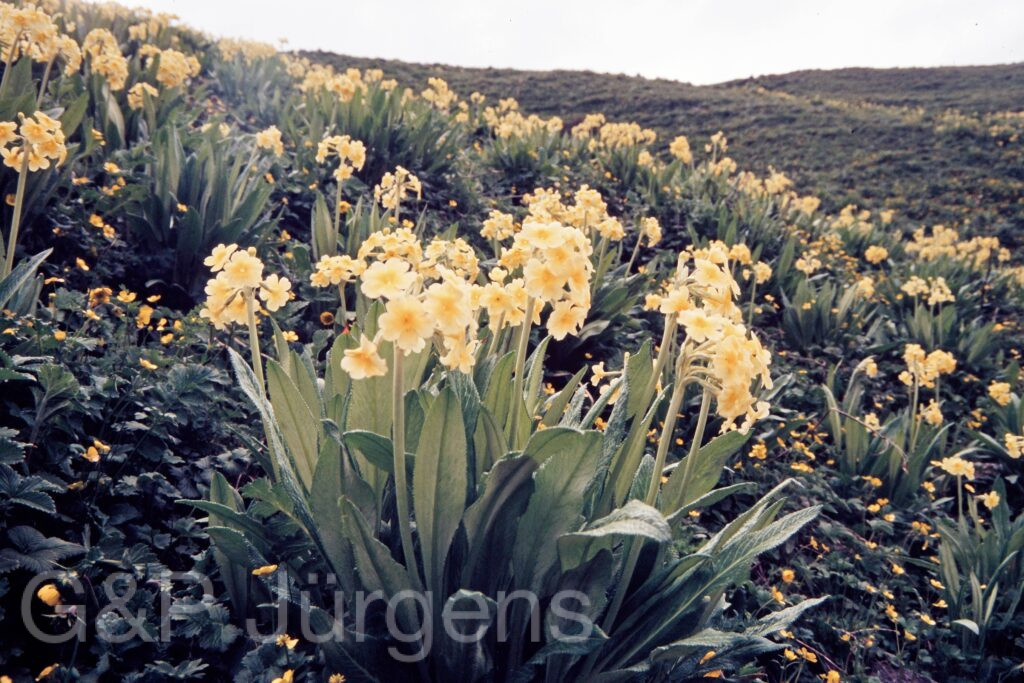
Primula stuartii is a high-alpine perennial distributed across the Himalayan arc, with georeferenced records (some 140 occurrences) from Nepal, India, China and Bhutan. It is a plant of open, moist alpine meadows, rocky slopes and the margins of melting snow-beds, typically occurring between roughly 3000 and 4500 m. The population photographed in the Garhwal Himalaya of northern India at about 3900 m in June represents its characteristic habitat, flowering as the snow recedes and the short summer growing season begins on humus-rich, well-drained but seasonally saturated substrates.
The species forms a stout perennial rosette arising from a short, farinose-coated rootstock. The leaves are oblong to oblanceolate, narrowing into a winged petiole, with finely toothed margins and a conspicuous mealy-yellow farina coating the lower surface. A robust scape bears a terminal umbel of several to many flowers; the calyx is tubular-campanulate and the corolla is bright golden-yellow with a distinct annulate throat, the limb divided into spreading, often emarginate lobes. The capsule is cylindrical, exceeding the calyx, and dehisces by apical valves to release numerous small angular seeds.
Primula stuartii belongs to the large and taxonomically complex genus Primula, within which yellow-flowered farinose Himalayan species have long posed problems of delimitation; several segregates and varieties have been recognised in the regional literature. As a snow-bed and alpine-meadow specialist it is sensitive to grazing pressure and to shifts in snow-cover duration, making it a useful indicator of alpine ecosystem change. It remains locally frequent across much of its range and is not presently regarded as threatened.
Author: Wall. · Sources: POWO (Kew), GBIF, Flora of Nepal, Flora of Bhutan, Flora of China, Smith & Fletcher's monograph of Primula