
Schott
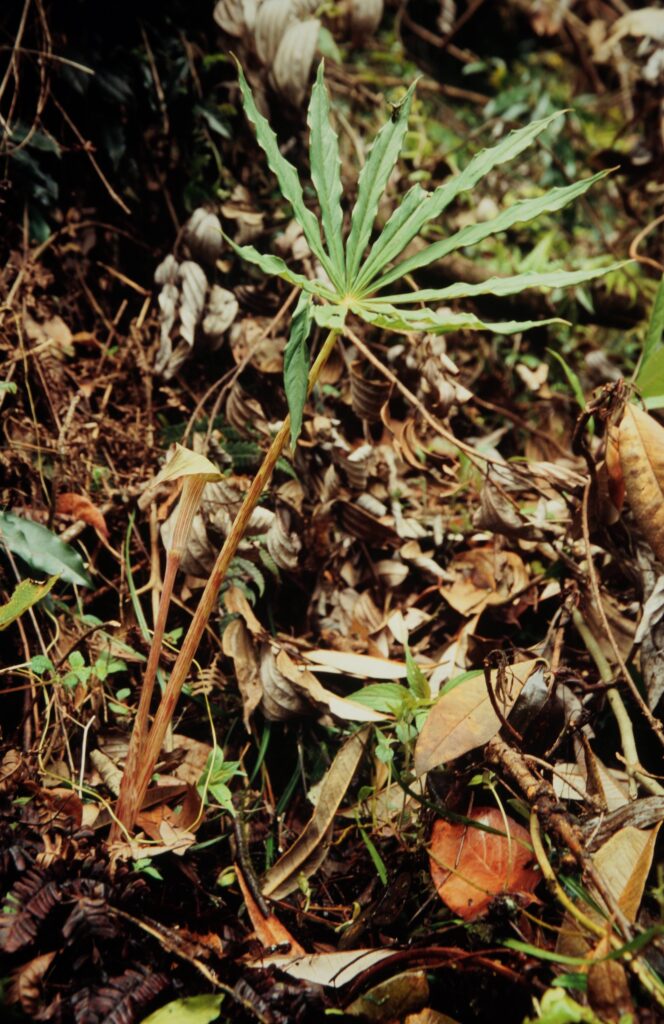
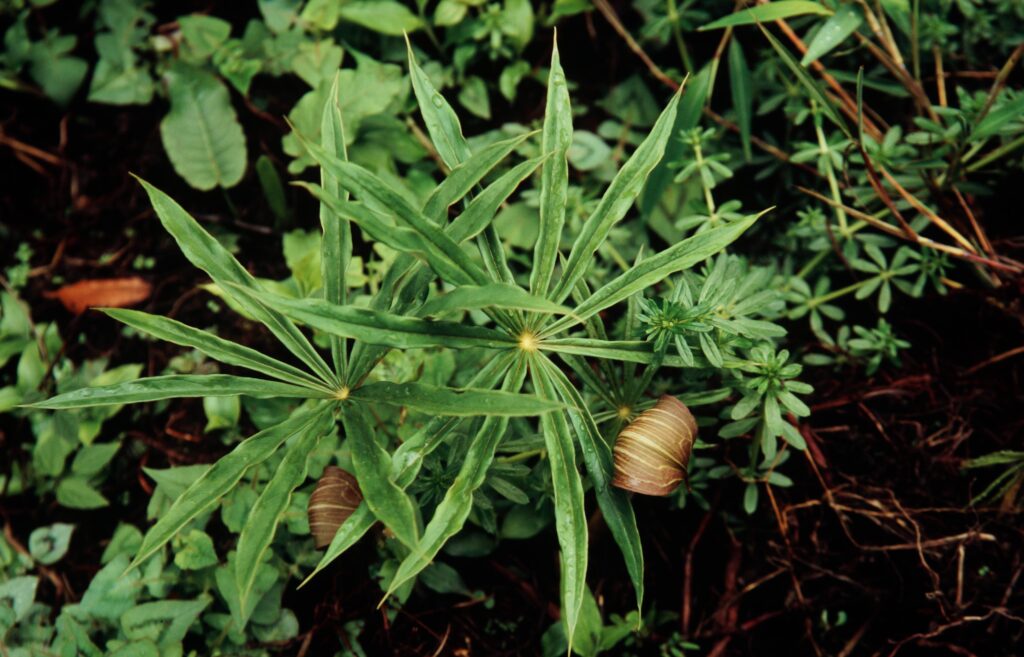
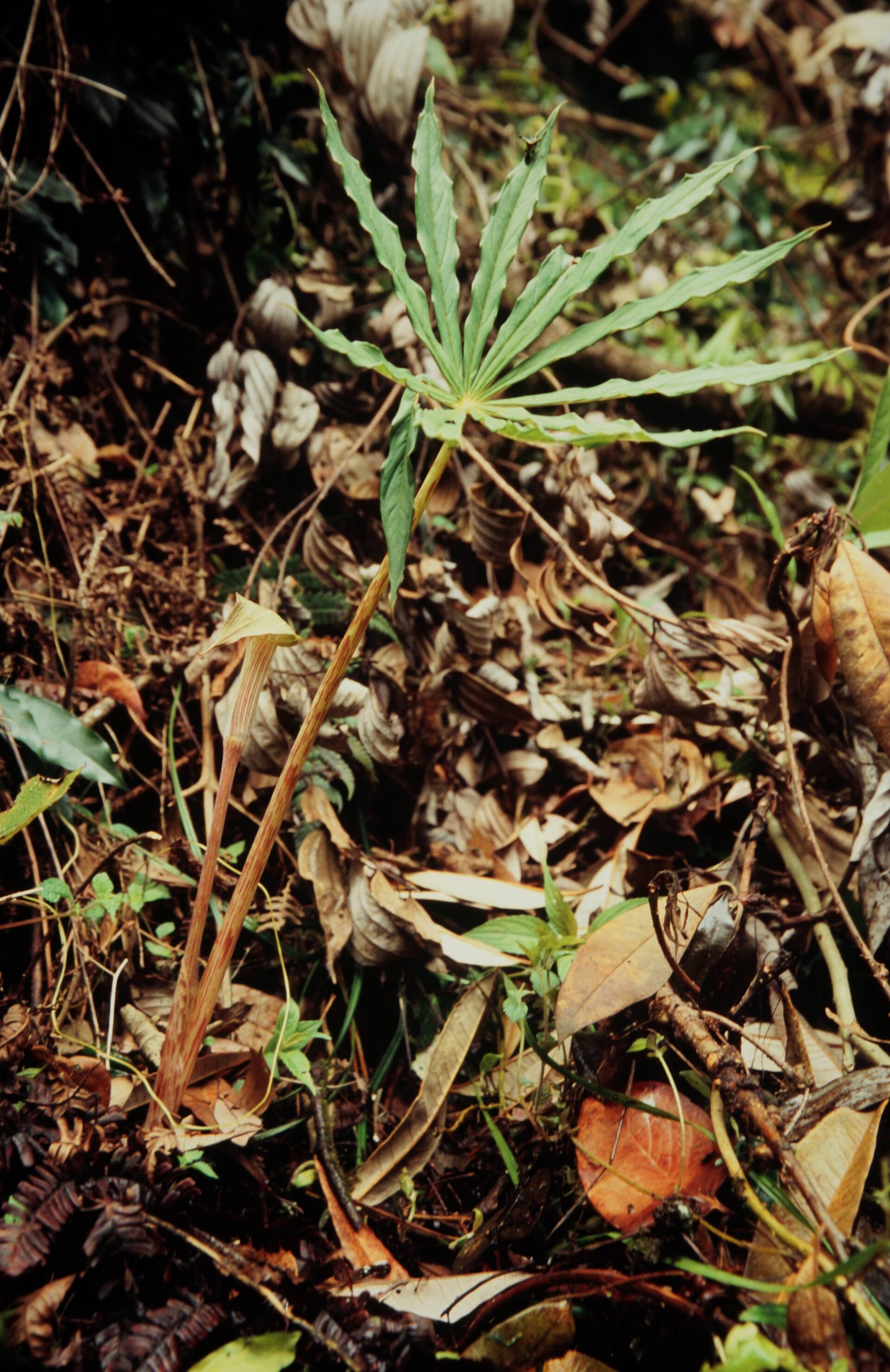
Both: Nepal Bolgoan, 1980m, May
Description
Arisaema erubescens is a widespread tuberous aroid distributed from the Himalaya across much of eastern and southeastern Asia. Its extensive range spans Nepal, northern India (from Uttarakhand to Arunachal Pradesh), Bhutan, Myanmar, Thailand, Vietnam, Taiwan, and much of China, with naturalised populations reported from several other countries. GBIF records over 1,350 occurrences, reflecting its broad distribution. The species inhabits the understorey of subtropical and warm temperate broadleaved forests, forest margins, and shaded ravines at elevations of 900–3,000 m. The photograph from Bolgoan in Nepal at 1,980 m, taken in May, shows the species during its characteristic spring emergence.
The plant arises from a depressed-globose tuber, 2–5 cm in diameter. The pseudostem is 15–40 cm tall, sheathed by cataphylls. Leaves are usually solitary, pedate with 7–15 leaflets; leaflets are elliptic to lanceolate, acuminate, the central one largest, 8–18 cm long, with entire or slightly undulate margins. The spathe is 8–15 cm long, with a tubular lower portion that is green striped with white or pale purple, and an arching, ovate-lanceolate limb that is typically purple-brown to dark maroon — the blushing colour referenced in the epithet erubescens. The spadix appendage is elongate, cylindrical, projecting well beyond the spathe tube, often sigmoid or pendulous. Plants are dioecious or sequentially monoecious. The infructescence is a dense cluster of bright red, globose berries.
Arisaema erubescens is taxonomically variable across its vast range, and several varieties have been described, including var. erubescens and var. onoticum. The species complex has been the subject of considerable systematic revision, as morphological boundaries with related taxa such as A. consanguineum can be subtle. It is one of the most commonly encountered Arisaema species in Himalayan forests and is not considered threatened. The tubers contain calcium oxalate crystals and are toxic if ingested raw, though they have been used in traditional medicine in several cultures.
Author: Schott · Sources: POWO (Kew), GBIF, Li & Hay: Araceae in Flora of China Vol. 23, Pradhan: Himalayan Cobra-Lilies (1997)