
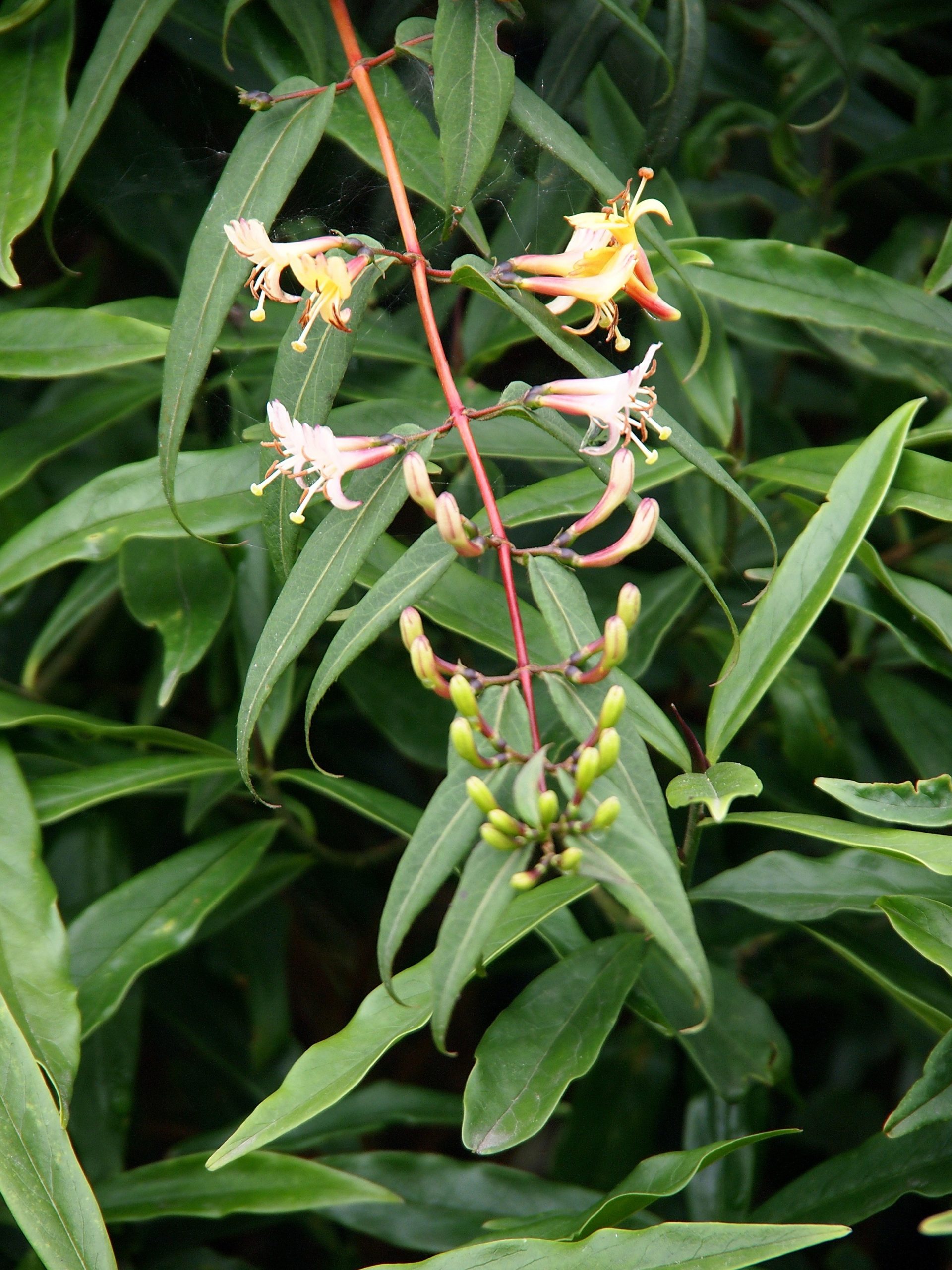
Wall.
Description
Lonicera acuminata is a widespread evergreen or semi-evergreen climbing honeysuckle distributed across the Himalaya and montane East and Southeast Asia, with native records from China, Taiwan, Japan, Nepal, India, Bhutan, the Philippines and Indonesia, alongside numerous cultivated and naturalised occurrences in Europe and North America; GBIF documents over 12,000 occurrences. It inhabits forest margins, thickets, ravines and scrubby slopes, mostly between 1000 and 3000 m, scrambling over shrubs and trees in mixed broadleaf and conifer forest. The Bhutanese photograph from Paro at about 2400 m in June shows it flowering in its typical mid-elevation woodland-edge setting.
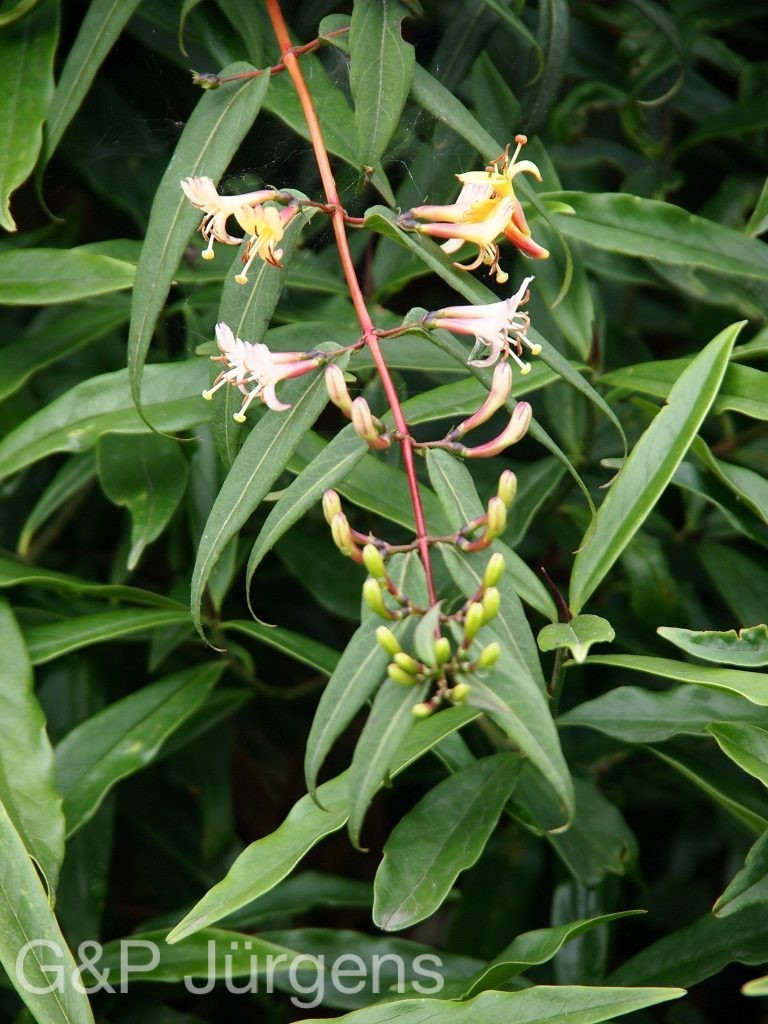
The plant is a twining woody liana with slender, often purplish, hairy young branches. The leaves are opposite, ovate-oblong to lanceolate, acuminate at the apex as the epithet indicates, entire, and frequently ciliate and pubescent along the margins and veins. The flowers are paired in the leaf axils on short peduncles, the corolla bilabiate and tubular, opening pale yellow and often suffused with reddish or purplish tones, the slender tube exceeding the lobes and the stamens and style exserted. The bracts are small and the calyx teeth short. The fruit is a small globose to ovoid berry, ripening purple-black and bearing few seeds.
Within the large, taxonomically intricate genus Lonicera (Caprifoliaceae), L. acuminata belongs to the climbing subgenus Periclymenum and shows considerable variation in indumentum and leaf form across its range, accounting for a long list of synonyms. Its tubular, exserted-stamen flowers point to pollination by long-tongued insects, while the fleshy berries are dispersed by birds. Broadly distributed and frequent, it is of no conservation concern and is grown ornamentally for its fragrant flowers and vigorous growth.
Author: Wall. · Sources: POWO (Kew), GBIF, Flora of China, Flora of Bhutan, Annotated Checklist of the Flowering Plants of Nepal, Rehder's revisions of Lonicera