
Schott
Description
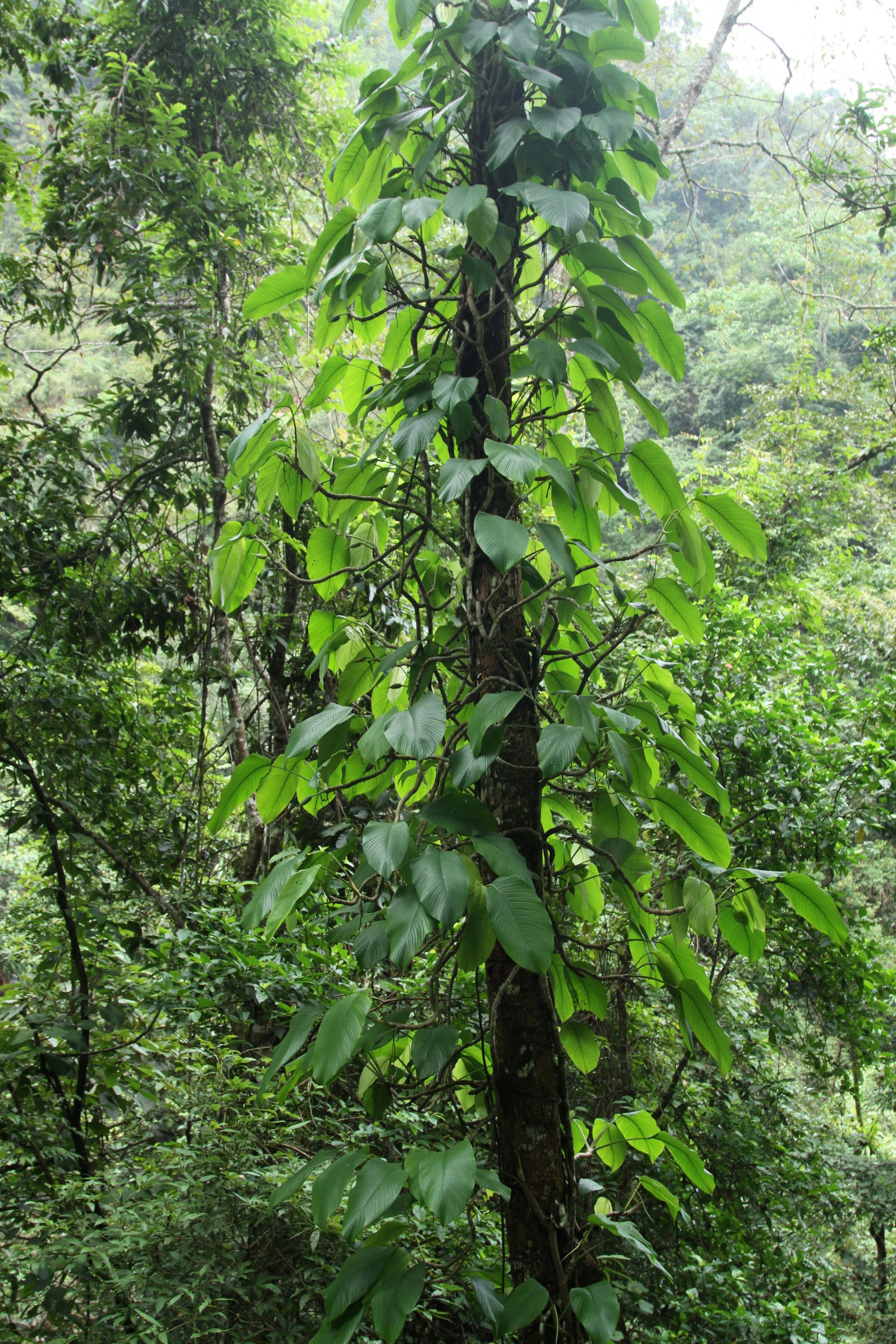
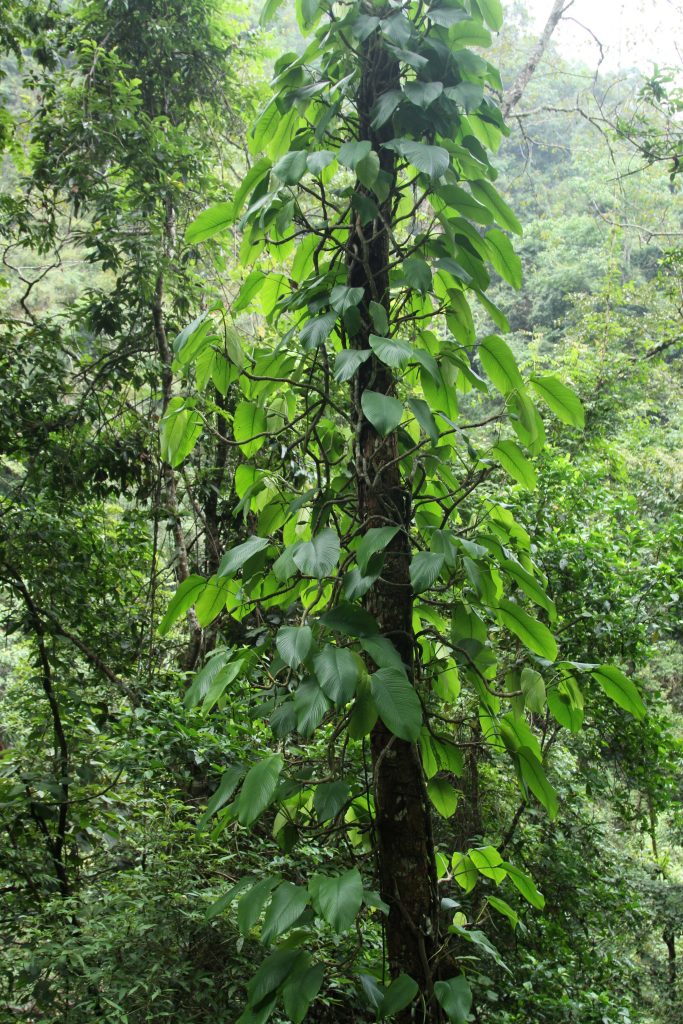
Rhaphidophora hookeri is a robust root-climbing aroid of the warm-temperate and subtropical broad-leaved forests of the eastern Himalaya and northern Indochina. GBIF occurrences place it across China, Thailand, India, Vietnam, Bhutan, Laos, Bangladesh, Myanmar and Nepal, with around 253 records reflecting its sparse but wide montane distribution. It is a hemiepiphyte of humid, shaded forest, ascending tree trunks and rock faces by adventitious clasping roots in evergreen ravines and along stream margins. The photographed plant from Zemgang in central Bhutan at 1500 m, recorded in October, is typical of the mid-elevation foothill forests where the species favours high atmospheric humidity, deep shade and moss-covered substrates.
It is a perennial climber with thick, fleshy stems that adhere closely to the support, the internodes marked by prominent scars and bearing dense feeding roots. The leaves are large, glossy and entire to obliquely ovate-elliptic, the petioles geniculate and sheathing at the base. The inflorescence is a cylindrical spadix subtended by a thick, deciduous, boat-shaped spathe; the flowers are bisexual and naked, lacking a perianth, densely packed over the spadix. The fruit is a fleshy syncarp of berries, releasing numerous small seeds at maturity.
The genus Rhaphidophora comprises some hundred species of palaeotropical climbing aroids, distinguished within the Monstereae by their bisexual flowers and the absence of a perianth. R. hookeri, named in honour of J. D. Hooker, is one of the few representatives reaching the Himalayan region. Like related climbing aroids it shows marked heteroblastic development, juvenile shingle-leaved shoots differing strongly from the adult climbing stems, an adaptation to the vertical microhabitats of dense forest interiors.
Author: Schott · Sources: POWO (Kew), GBIF, Flora of Bhutan, Flora of China (Araceae), Revision of Rhaphidophora (Boyce, Araceae monographs)