
Hook. f.
Description
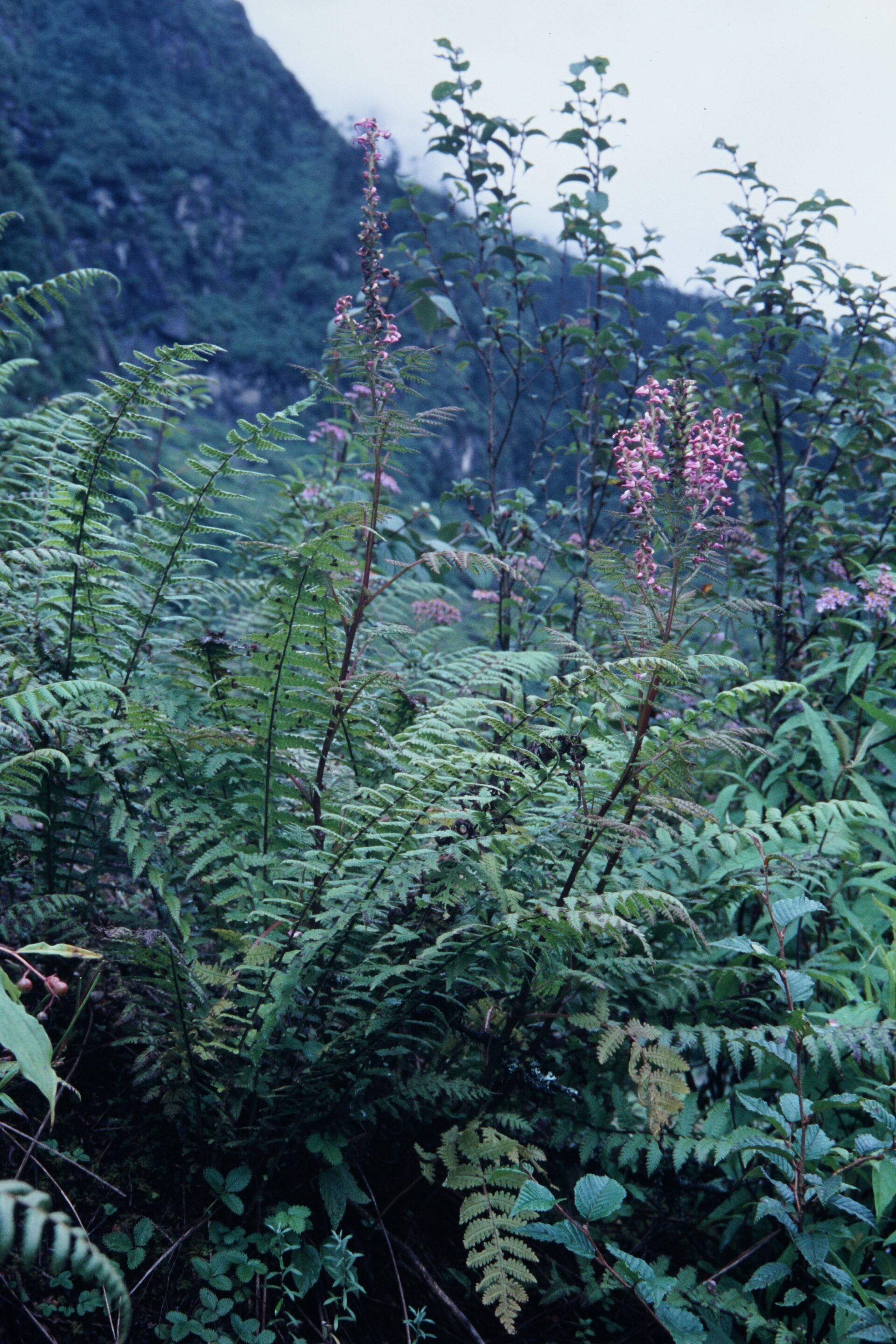
Pedicularis excelsa is a tall hemiparasitic herb of the eastern Himalaya, recorded from Bhutan, India, Nepal, China and Mongolia; with only about 42 georeferenced records it is a regionally restricted subalpine to alpine species. It grows in open subalpine meadows, moist grassy slopes, forest clearings and streamsides, typically between 3000 and 4200 m. The plant photographed in the Lachung Valley of Sikkim at 3600 m in August occupies the monsoon-flushed alpine meadow zone, flowering at the height of the short Himalayan summer alongside other tall meadow herbs.
As the epithet "excelsa" suggests, it is among the taller lousteworts, an erect herb 40-100 cm tall with a stout taproot that forms haustorial connections to neighbouring plant roots. The stem bears pinnatisect leaves with toothed segments, partly basal and partly cauline. The flowers are crowded into a dense, elongate terminal spike; each corolla is strongly bilabiate, pink to purplish-red, with the upper lip (galea) compressed and beaked, enclosing the four didynamous stamens, and a broad spreading three-lobed lower lip. The calyx is tubular and toothed. The fruit is an oblique, beaked capsule containing several seeds.
Described by Hooker f. (Hook. f.), P. excelsa belongs to the large genus Pedicularis, now placed in the Orobanchaceae (formerly Scrophulariaceae), which reaches extraordinary diversity in the Sino-Himalaya. As a root hemiparasite it supplements its own photosynthesis by tapping host roots. The beaked galea is adapted to pollination by long-tongued bumblebees, which the Himalayan Pedicularis radiation has exploited through diverse corolla forms. Its restricted range and meadow habitat make it sensitive to overgrazing, though no formal threat status is assigned.
Author: Hook. f. · Sources: POWO (Kew), GBIF, Flora of Bhutan, Flora of China, Flora of Sikkim Himalaya, Prain's revision of Indian Pedicularis (Orobanchaceae)