
G.Watt

Description
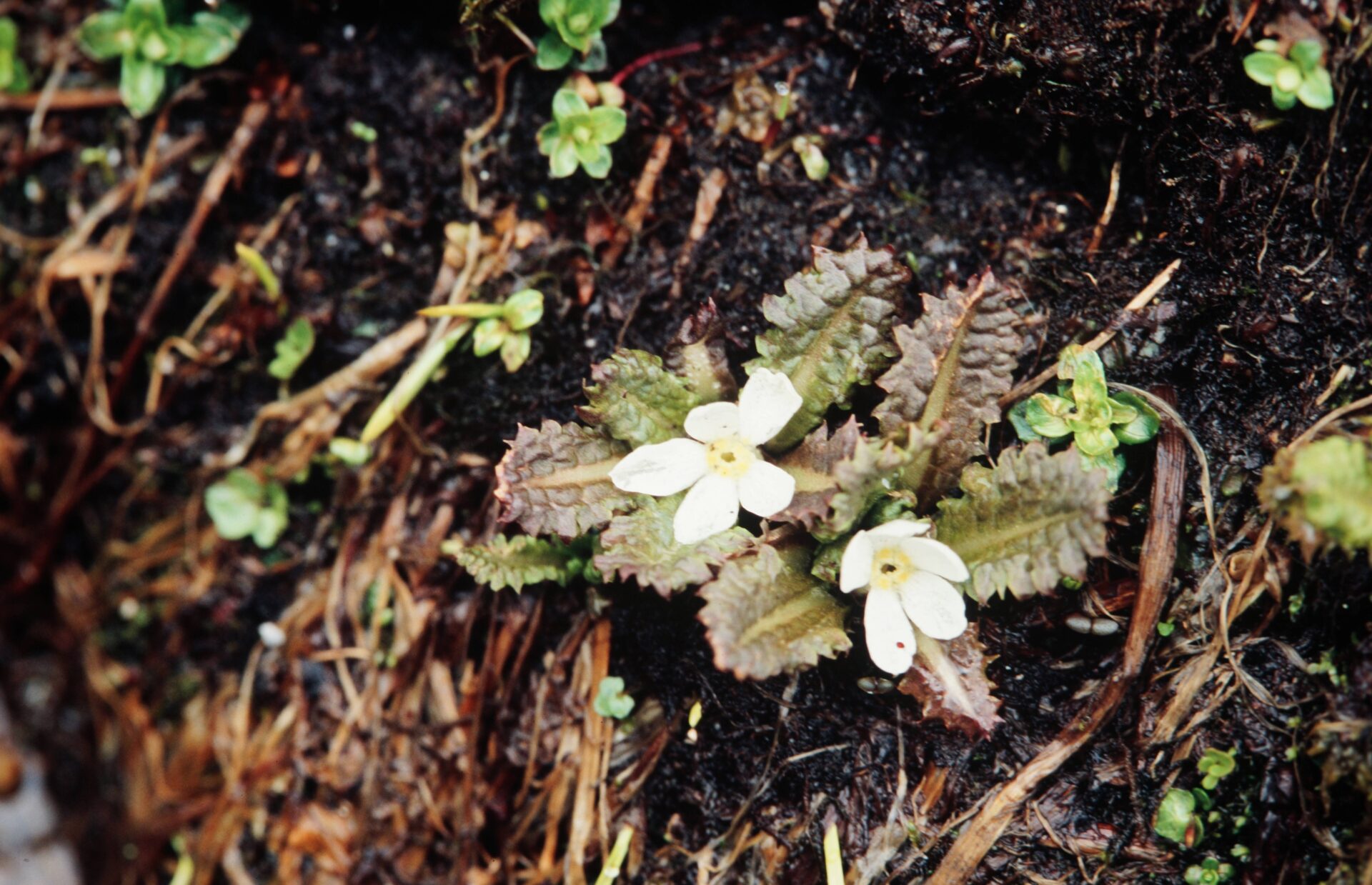
Primula hookeri is a diminutive alpine primrose of the eastern Himalaya, recorded from China, Nepal, India, Bhutan and Myanmar. It is a plant of high alpine meadows, mossy banks, rhododendron scrub margins and moist turf near the treeline and above, typically between about 3300 and 4500 m. The photographed plant from Kishong in West Bengal, India, at around 3600 m and flowering in May, is characteristic of its early-season blooming soon after snowmelt in cool, humid, high-montane meadow where moisture from melting snow and abundant atmospheric humidity sustain the small rosettes.
The species is a small, tufted perennial forming neat basal rosettes. The leaves are obovate to spathulate, narrowed to a winged petiole, crenate to denticulate, glabrous or nearly so, and lack the conspicuous farina of many Himalayan primulas. The flowers are typically solitary or few on short scapes, sometimes nearly sessile among the leaves; the corolla is white to pale lilac with a yellow eye, salverform, with an elongated tube and spreading, notched lobes. The fruit is a small capsule shorter than or about equalling the persistent calyx, releasing numerous minute seeds.
The epithet honours Sir Joseph Dalton Hooker, whose mid-nineteenth-century Sikkim explorations transformed knowledge of Himalayan Primula. The species belongs to the small-flowered section Minutissimae (the dwarf alpine primulas), a group of cushion- and turf-forming high-elevation specialists. Like many narrowly montane primulas it is heterostylous, promoting outcrossing. Restricted to fragile high-alpine habitats, such species are potentially sensitive to grazing and warming-induced upslope vegetation shifts, though P. hookeri is not presently regarded as threatened.
Author: G.Watt · Sources: POWO (Kew), GBIF, Flora of China Vol. 15, Flora of Bhutan Vol. 2, Flora of Nepal, The Genus Primula (Richards)