
(H.Hara) Al-Shehbaz, G.Q.Hao & J.Q.Liu
Description
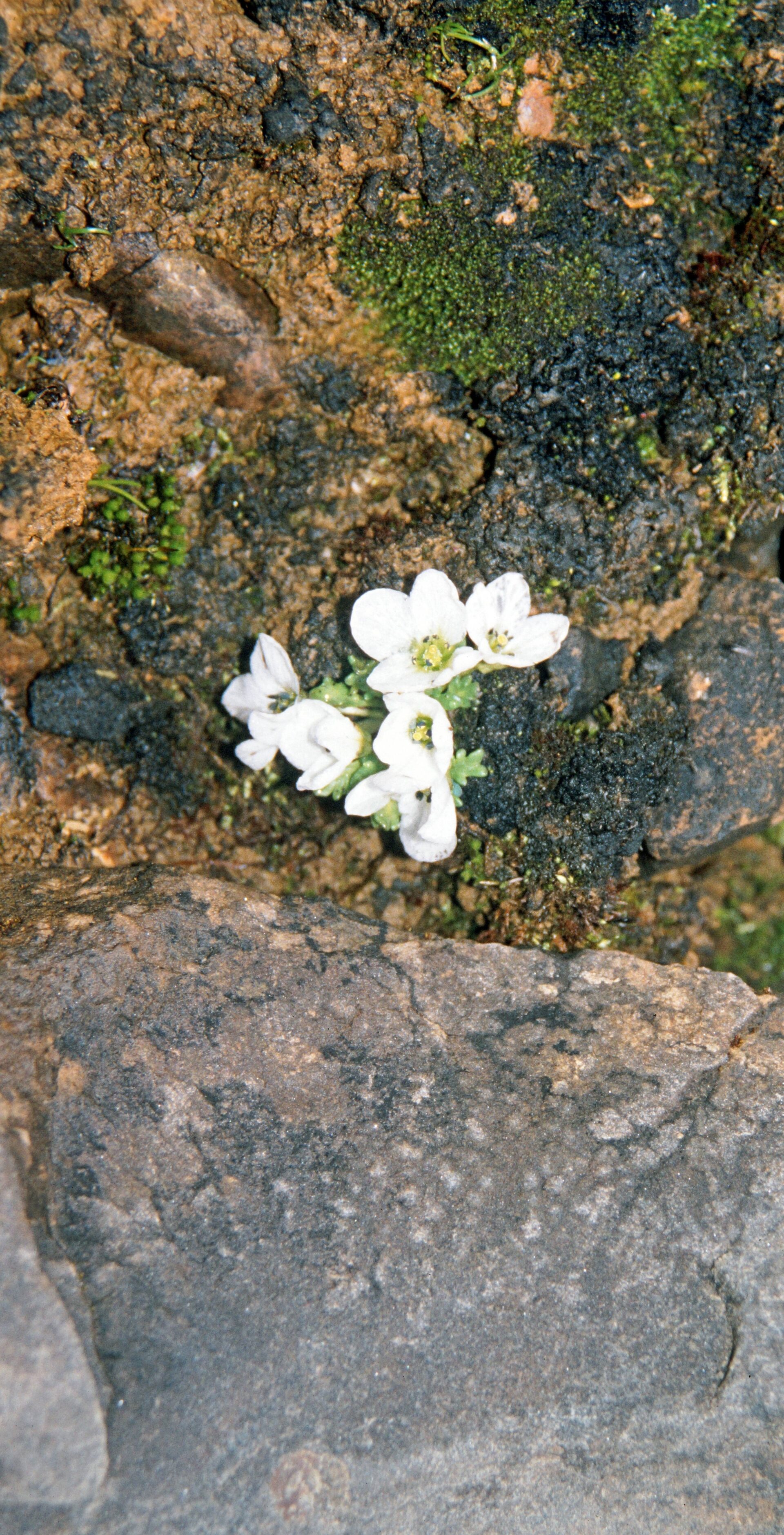
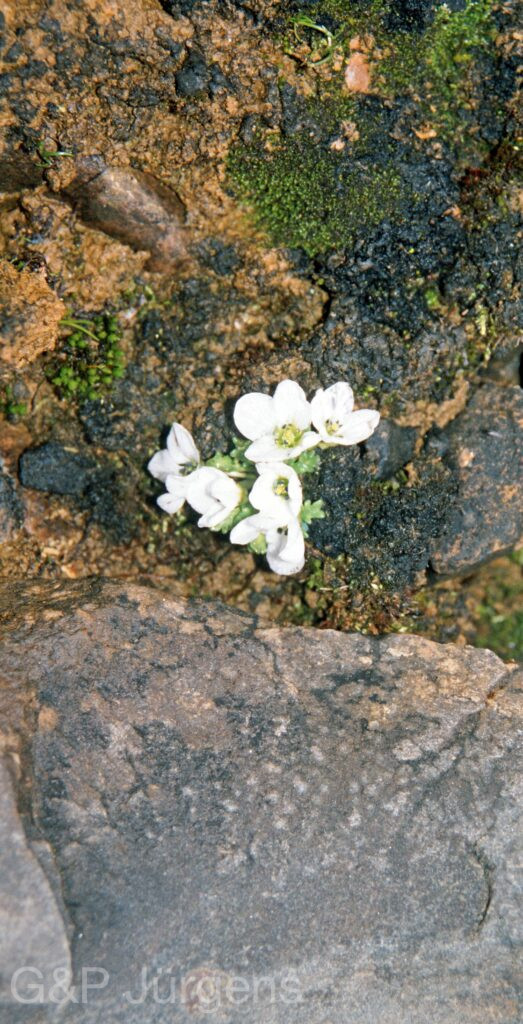
Aphragmus minutus is a diminutive crucifer of the highest Himalaya and adjacent Tibetan and Indo-Burmese mountains, recorded by GBIF (about 34 occurrences) from India, Nepal, Bhutan, Myanmar and China. It is a subnival specialist, growing on open scree, gravelly flats, moraine and fine-grained alpine soils close to the upper limit of vascular plant life, where it endures intense cold, wind and a very short growing season. The illustrated plant was found in West Nepal on the Kagmara La at about 5000 m in July, an elevation typical of the species and among the highest at which flowering plants occur in the region.
It is a tiny, low, cushion- or rosette-forming perennial, as the epithet minutus implies, arising from a slender taproot crowned by a branched caudex. The leaves are crowded, small, entire or slightly toothed, spathulate to oblanceolate, glabrous or nearly so. The flowers are borne in a short, congested raceme scarcely raised above the foliage; each has four greenish sepals and four small white to pale lilac petals in the cruciform arrangement of the family, with tetradynamous stamens. The fruit is a short, oblong to ellipsoid silicula with a persistent style, dehiscing to release a few seeds, its compact form an adaptation to the brief alpine summer.
The species was transferred to Aphragmus on molecular and morphological grounds, the binomial (H. Hara) Al-Shehbaz, G. Q. Hao and J. Q. Liu reflecting that recombination; Aphragmus is a small high-Asian genus of the Brassicaceae centred on the Himalaya and Tibetan Plateau. As an extreme high-altitude cushion plant it is naturally rare and very localised but faces few direct threats beyond climate change, which may compress the habitat of such ceiling-dwelling alpines.
Author: (H.Hara) Al-Shehbaz, G.Q.Hao & J.Q.Liu · Sources: POWO (Kew), GBIF, Flora of China, Flora of Bhutan, Annotated Checklist of the Flowering Plants of Nepal, Al-Shehbaz's systematic studies of Asian Brassicaceae