
Wall.
Description
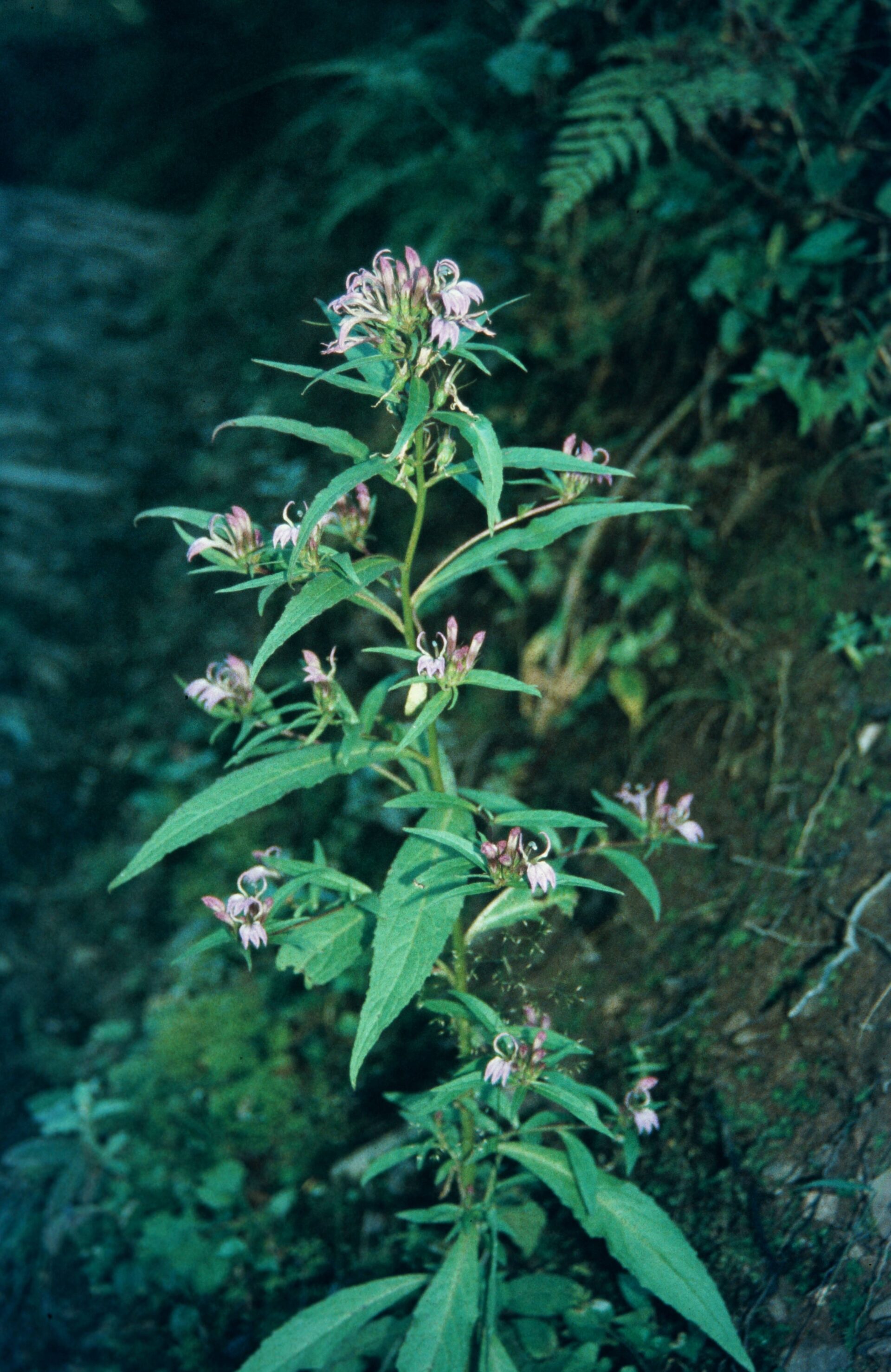
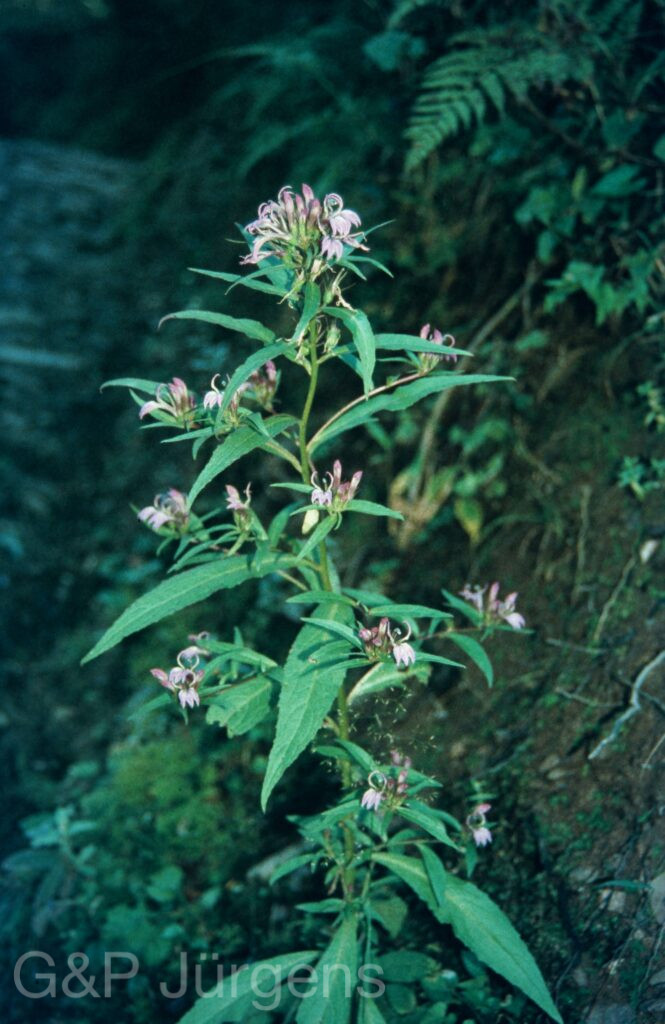
Lobelia pyramidalis is a widespread Asian lobelia ranging through the Himalaya and into mainland Southeast Asia and southern China, with GBIF records from India, Nepal, Bhutan, Bangladesh, China, Taiwan, Myanmar, Thailand and Japan (a few extralimital records from the United States represent cultivation or introductions). Its nearly 419 documented occurrences confirm a broad and well-collected distribution. The species grows on grassy banks, open hillsides, forest margins, roadside cuttings and moist disturbed ground from the lowlands up to roughly 2,800 m. The photographed plant from Didina in Garhwal, India, at 2,470 m flowering in September illustrates its preference for the temperate Himalayan zone, where it flowers late in or after the monsoon.
The plant is an erect biennial or short-lived perennial herb with a tall, simple, pyramidal flowering stem reaching up to a metre or more. The leaves are alternate, sessile and crowded below, lanceolate to oblanceolate with finely toothed margins, the lower ones forming a basal rosette. The inflorescence is a long, dense, spike-like terminal raceme of many small zygomorphic flowers, each subtended by a leafy bract; the corolla is bilabiate and pale blue to lilac or whitish, with the two upper lobes erect and the three lower lobes spreading. The fruit is a small two-valved capsule containing numerous minute seeds.
The species belongs to Lobelia subgenus Tupa-related Asian lineages and, like its congeners, contains piperidine alkaloids that render it acrid and medicinally noteworthy in folk traditions. Its tolerance of disturbed and secondary habitats makes it locally common and of no conservation concern. Its wide latitudinal and altitudinal amplitude makes it a useful indicator of the disturbed grassland flora across monsoonal Asia.
Author: Wall. · Sources: POWO (Kew), Flora of China Vol. 19, Flora of Bhutan Vol. 2, GBIF, Lammers: World Checklist and Bibliography of Campanulaceae