
(D.Don) C.Norman
Description
Cortia depressa is a cushion-forming alpine umbellifer distributed from Nepal through Sikkim, Bhutan, and northeast India into upper Myanmar and southwestern China (Yunnan, Xizang). GBIF records 284 occurrences, indicating a moderately well-collected species. It is characteristic of high-altitude open habitats including alpine meadows, rocky screes, dry turf, and exposed ridgetops at elevations of 3,200–4,800 m. The species is well adapted to the extreme conditions of the alpine zone, where it tolerates intense solar radiation, frost, and wind exposure by maintaining an extremely compact growth form pressed close to the substrate.
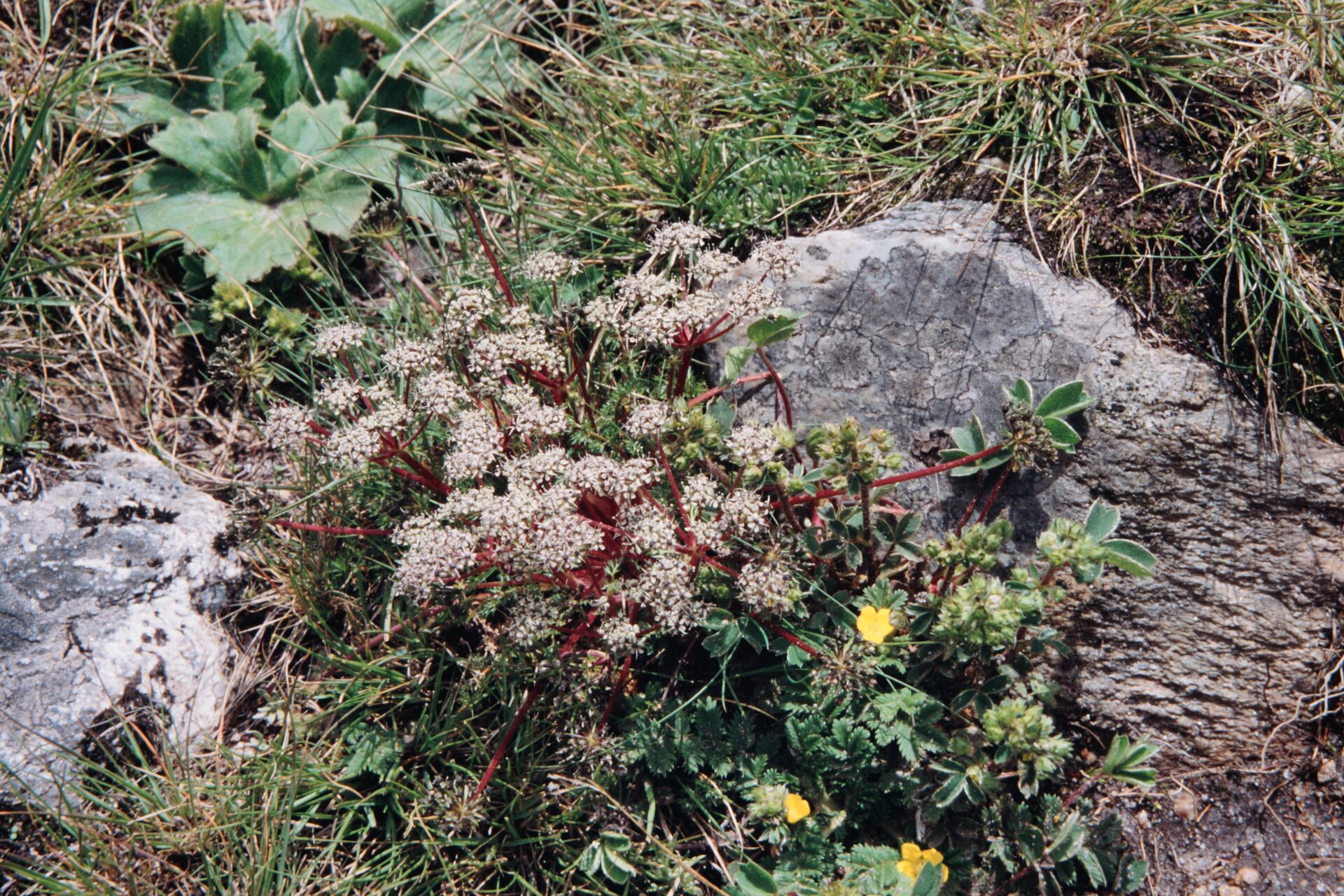
Cortia depressa is a dwarf, depressed-caespitose, perennial herb arising from a stout, woody taproot. The entire plant is typically only 2–5 cm tall, forming dense rosettes or low mats. Leaves are pinnately or bipinnately dissected into small, crowded, linear segments, 1–3 cm long, with sheathing petiolar bases that are often purple-tinged and somewhat scarious. The inflorescence is a simple or compound umbel, sessile or on very short peduncles barely exceeding the foliage. Umbellules are compact, with minute, white to pinkish flowers, 1–2 mm across, each with five petals and five stamens. The involucral and involucellar bracts are conspicuous relative to the diminutive plant. The fruit is a compressed, ellipsoid cremocarp, 3–5 mm long, with prominent dorsal ridges and well-developed vittae.
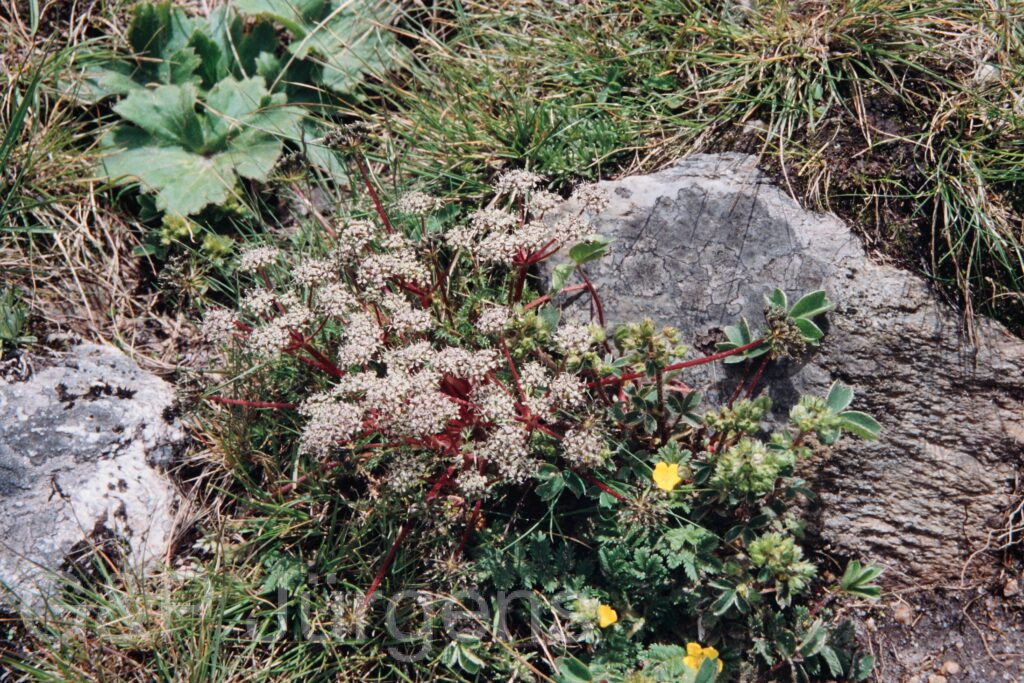
The photographed specimen from Loccu in western Nepal at 3,800 m in June documents an early-monsoon flowering occurrence, consistent with the brief alpine growing season. Cortia is a small genus of five to eight species endemic to the Sino-Himalayan region, and C. depressa is the most widespread member. It is distinguished from the related C. lindleyi by its more strongly depressed habit and sessile to subsessile umbels. The species exemplifies morphological adaptations to alpine environments — dwarfism, dense pubescence, and compact rosette architecture — that minimize heat and water loss. It serves as an indicator species for well-preserved alpine turf communities across the Himalayas.
Author: (D.Don) C.Norman · Sources: POWO (Kew), GBIF, Flora of China Vol. 14, Flora of Nepal Checklist, Pimenov & Leonov: The Genera of Umbelliferae (1993)